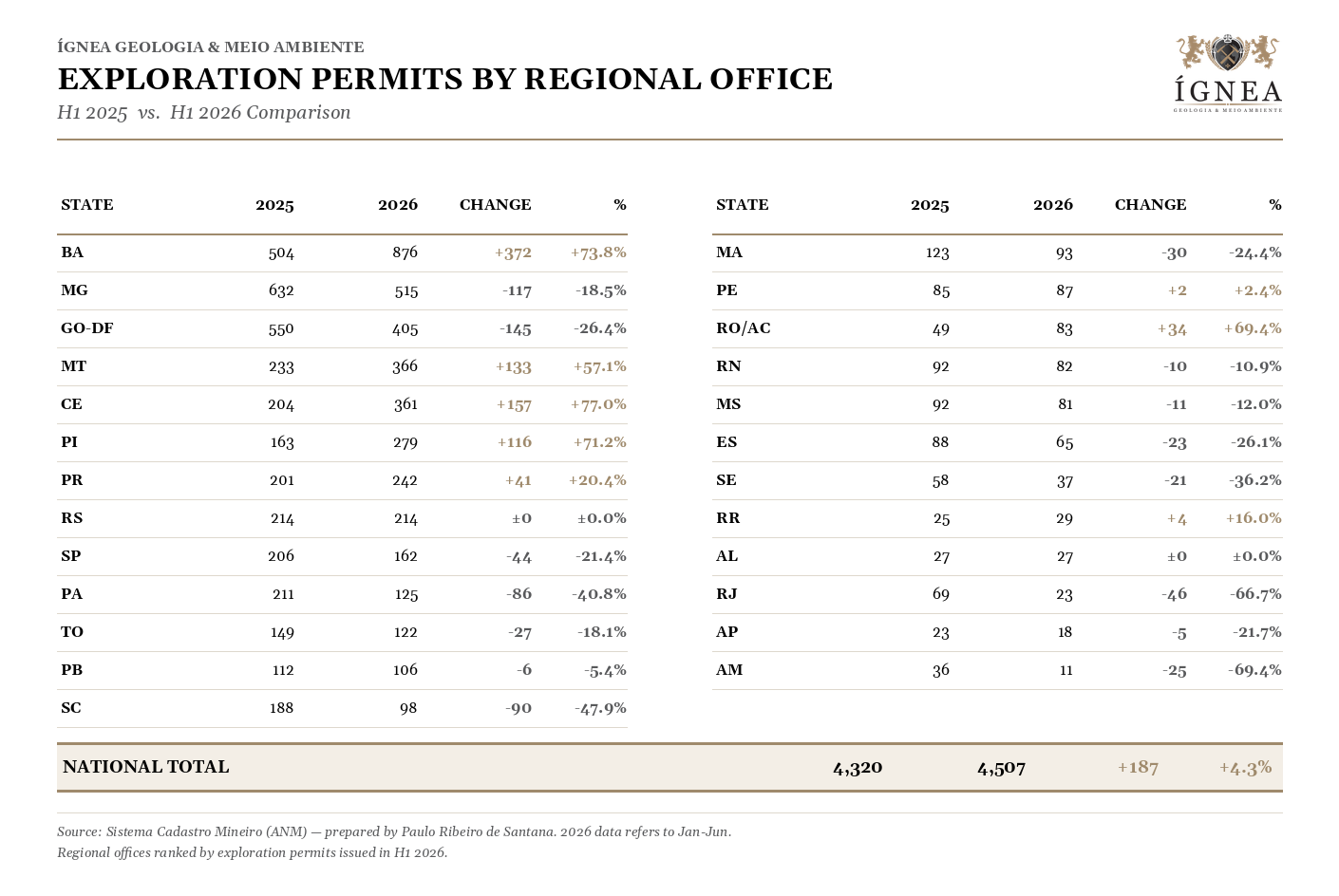
The first half of 2026 concluded with 4,507 Exploration Permits published by the ANM. This volume represents a 4.33% increase compared to the same period in 2025, when 4,320 titles were issued. Beyond national growth, the year-over-year comparison reveals a shift in leadership among the primary mining states.
The Bahia Regional Office claimed the 1st position in the semi-annual ranking, issuing 876 permits (19.44% of the national total) between January and June 2026. During the same interval in 2025, Bahia ranked only third, with 504 titles, reflecting a significant 73.81% surge in permit approvals and climbing two positions in the ranking in just one year.
Conversely, Minas Gerais surrendered the top spot. After leading the first half of 2025 with 632 approvals, the state fell to 2nd place in 2026 with 515 permits (11.43% of the total). This 18.51% decline in issuance reflects a slowdown in the regional office’s processing throughput compared to the previous year.
Goiás/DF, in turn, dropped one position in the ranking: from 2nd place in H1 2025, with 550 titles, to 3rd place in 2026, with 405 permits, a 26.36% decline in issuance volume. Further down the 2026 rankings, Mato Grosso climbed to 4th place with 366 permits (up from 233 in 2025), outpacing Ceará, which recorded 361 titles (compared to 204 the previous year). Piauí also gained momentum, securing 6th place with 279 approvals in 2026, up from 163 in the first half of 2025.
Monthly Issuance Volume
In terms of monthly workflow, the ANM demonstrated higher delivery capacity toward the end of the semester in 2026. While the 2025 output peaked in January (996 permits), the highest throughput in 2026 concentrated in June, with 975 publications. This shift raised the agency’s monthly average from 720 titles in the first six months of 2025 to 751 permits per month in 2026.
📷 AI-Generated Image