Rare earths are taking up a growing share of the debate in the mineral sector, in Brazil and abroad. Used in magnets, electronics and high-technology equipment, they have become a recurring topic in discussions on supply chains, the energy transition and industrial development. Understanding the path these minerals follow, from the identification of potential to production, is part of that debate. In this context, MCE 360, the Critical and Strategic Minerals Portal of the National Mining Agency (ANM), brings together official data on each stage of mining activity and lets users track where rare earths stand in the country.
ANM presented the platform on Wednesday (October 14) at an event held at the agency’s headquarters in Brasília. Developed by ANM’s Mineral Economy and Geoinformation teams in partnership with Imagem Geosistemas, the portal brings economic and geospatial data together in one platform, organized by substance, with the source and reference period indicated. It also offers maps, dashboards, publications and downloadable datasets. The link to the portal is provided at the end of this text.
A Snapshot in Numbers
According to the 2025 data published on the portal, Brazil produced 326 metric tons of rare earths in the form of oxide concentrate. In foreign trade, US$14.9 million in concentrate was exported and US$30.6 million in mineral processing products, such as oxides and magnets, was imported. There are currently 4 areas in the exploitation phase, all in Goiás. Analytically, these figures separate two things: what the country produces today and what it may produce from areas that are still in earlier phases.
| Stage | Quantity (ANM) |
|---|---|
| Locations with mineral potential identified by the Geological Survey of Brazil (SGB) | 75 |
| Areas in the exploration phase | 3,067 |
| Areas with an approved final exploration report or an application for exploitation | 78 |
| Areas in the exploitation phase | 4 |
The figures above do not form a single sequence of cases, since each category comes from a different database and criterion. For those following the sector, the useful reading is to place each project in its stage and identify the next requirement: completion of exploration and approval of the final report; the application for exploitation; and, in the production phase, environmental licensing and the investments tied to the operation.
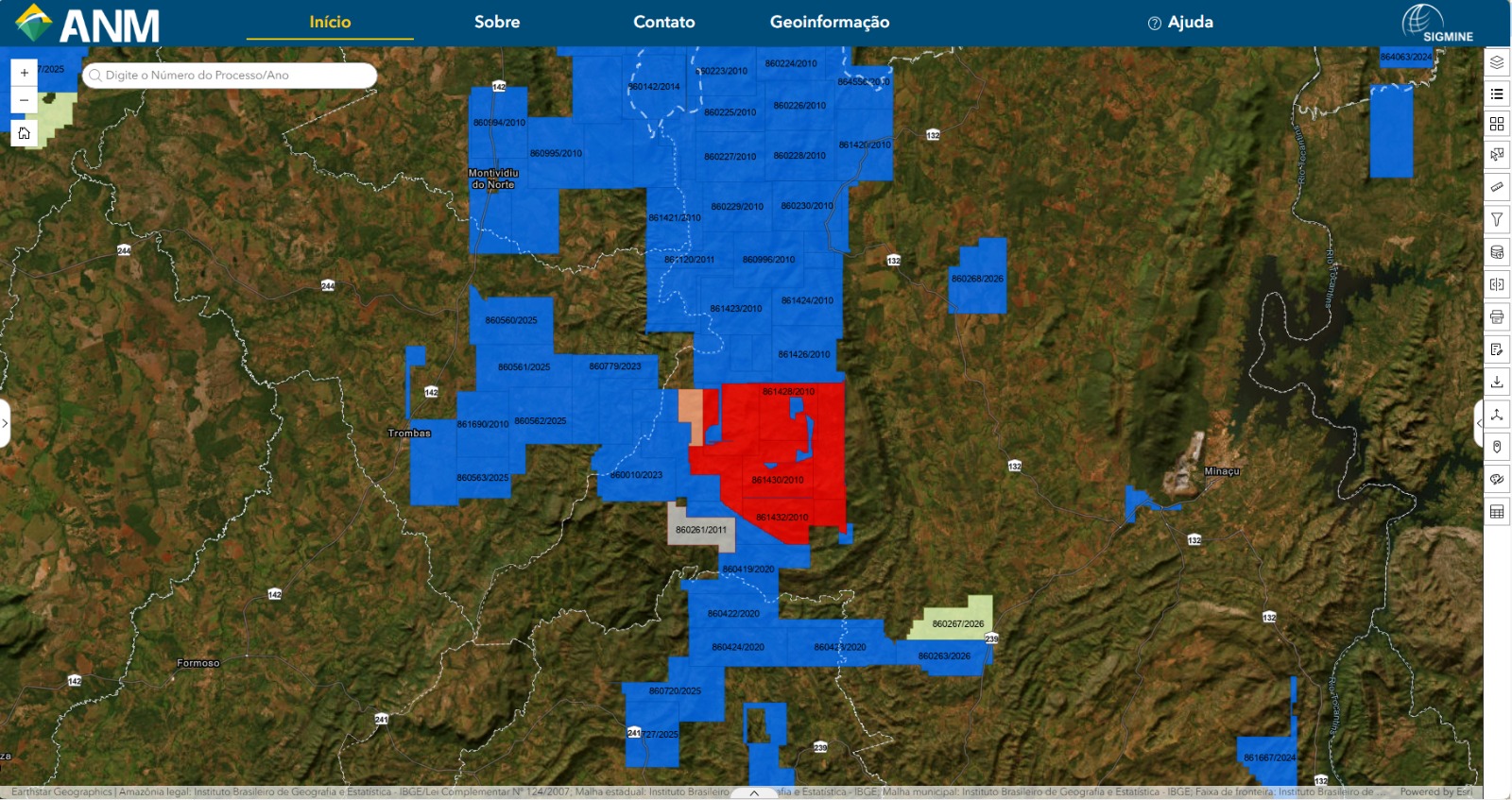
Figure: excerpt from SIGMINE showing the state of Goiás. In red, titles in the exploitation phase; in blue, titles in the exploration phase. Source: ANM/SIGMINE.
Points of Attention for Titleholders and Investors
In our advisory work, these data typically support four areas of work:
- Diagnosing the title portfolio: confirming which phase each tenement is in and which deadlines and requirements apply to it.
- Planning the transition between phases: moving from exploration to exploitation involves technical documentation and environmental planning, which should be handled in parallel.
- Analyzing the area of interest: public data by substance, state and municipality help identify other tenements in the region and the phase they are in.
- Due diligence: in purchase, partnership or investment transactions, the phase of the tenement and the regularity of its documentation are central points.
Where to Find the Data
The portal allows users to filter information by substance, state and municipality, and provides maps, dashboards and downloadable datasets. It is an official source that helps put a decision in context, but it does not replace the individual analysis of each tenement.
Access the portal: MCE 360
In Short
The portal’s data show that rare earths in Brazil are spread along the entire chain, from the identification of potential to exploitation, and that each stage has its own technical, environmental and documentary requirements. For titleholders and investors, the key is to know precisely where each title stands in the process and to plan the transition between phases in advance. It is in this reading, which combines public data with the analysis of the specific case, that advisory work adds value.
Source: ANM, Critical and Strategic Minerals Portal, and news release of October 14, 2026.
AI-generated image