Mining license data from the Sistema Cadastro Mineiro (Brazil’s national mining registry system), comparing the first seven months of 2025 and 2026, shows a national decline in activity: from 525 licenses granted between January and July 2025 to 428 in the same period of 2026, an 18.5% drop.
Taken in isolation, that number suggests a broad slowdown.
But breaking the data down by state reveals a more uneven picture. The national decline is not spread evenly across states: some of the country’s most traditional mining hubs declined little or not at all, while others fell sharply.
Stability prevails at the top of the ranking. Rio Grande do Sul, the leader in both periods, saw a variation of just -5.6% (from 72 to 68), within the expected range of month-to-month fluctuation. Mato Grosso, in second place, followed the same pattern, also declining by 5.6% (from 54 to 51).
Minas Gerais saw a somewhat larger drop of 10% (from 40 to 36), though still moderate.
The most interesting case at the top of the ranking is Goiás/Distrito Federal, which recorded the exact same number of grants in both periods: 57. At first glance, the state’s position in the 2026 ranking, up from 3rd to 2nd nationally, might look like a sign of growth.
But the data shows something else: there was no absolute increase, just stability in a scenario where its direct competitors lost ground.
It is precisely among the states that ranked near the top in 2025 that the decline is sharpest. Pará, 4th in that year’s ranking with 37 grants between January and July, fell to 17 in the same period of 2026, a 54.1% drop. Bahia, then in 5th place, followed a similar path, from 33 to 17 grants (-48.5%).
Alagoas, 8th in 2025, fell from 17 to 8 grants (-52.9%). Ceará, which actually ranked ahead of Alagoas that year (7th place, with 28 grants in the same period), posted the sharpest variation among the states analyzed: it dropped to just 6, a 78.6% decline.
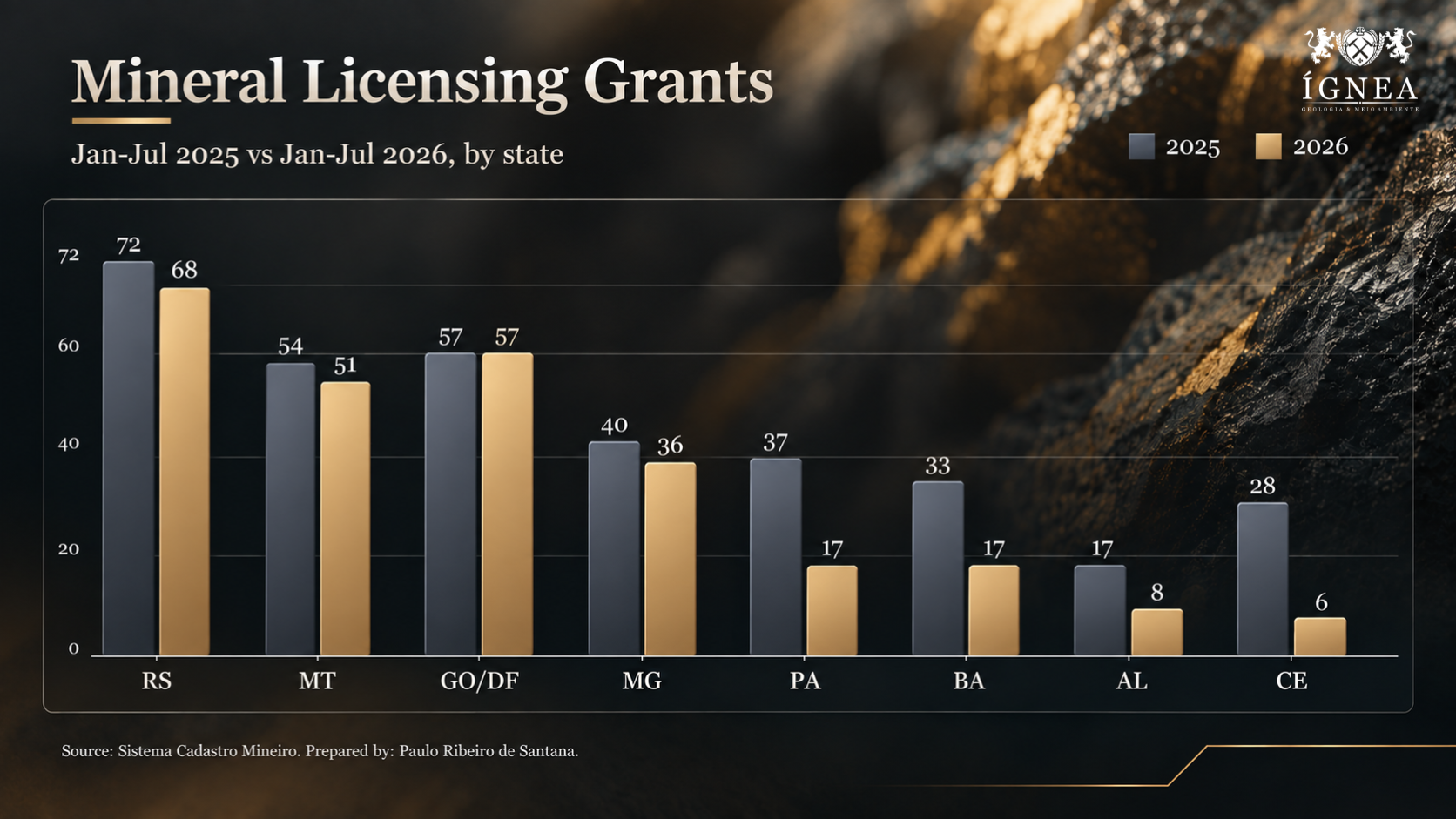
Taken together, the data suggests that 2026 is not simply “a weaker year” for mining licensing in Brazil, but a year in which activity became even more concentrated in already-established hubs: combined, Rio Grande do Sul, Mato Grosso, Goiás/Distrito Federal, and Minas Gerais accounted for 42.5% of the national total in January-July 2025, and rose to 49.5% in the same period of 2026. Meanwhile, other states, some of which had ranked well the year before, lost significant ground.
We will be watching whether this trend holds through the second half of the year, once complete 2026 data becomes available for comparison.
AI-Generated Image