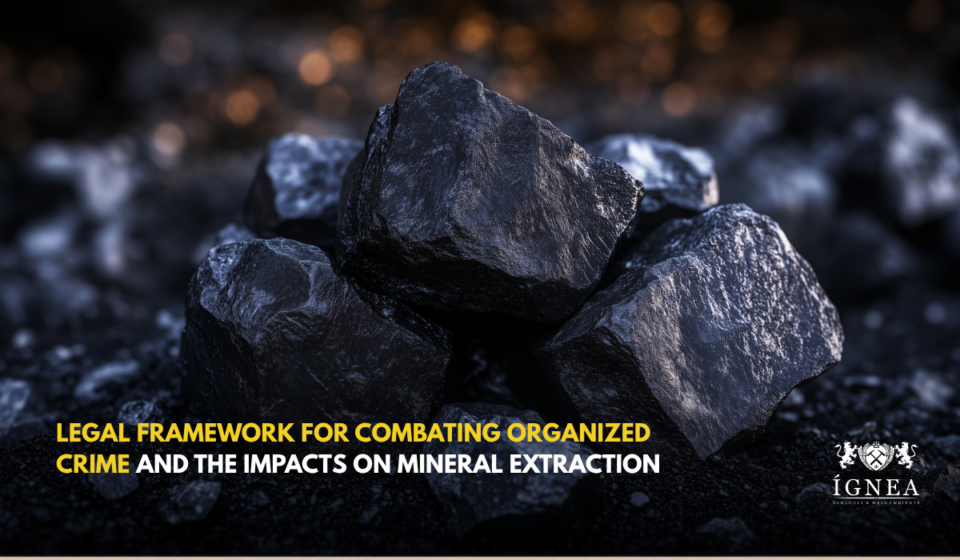
Published on March 25, 2026, Law No. 15,358 institutes the Legal Framework Against Organized Crime in Brazil, also known as the Raul Jungmann Law. The rule alters provisions of the Penal Code, the Code of Criminal Procedure, and the Heinous Crimes Law, establishing rigorous criteria for combating criminal organizations and private militias.
Although it has a broad public security scope, the new legislation brings direct implications for the mineral sector, especially regarding the stiffening of penalties for irregular Mineral Exploration when linked to criminal structures.
The point of greatest relevance for the mining sector is found in Article 2, Paragraph 1, item X. The law criminalizes the offense of “Structured Social Domain”, with imprisonment penalties ranging from 20 to 40 years.
The legislation establishes that the penalty will be increased by 2/3 (two thirds) to double if the crime is committed with the purpose of obtaining economic advantage through the illegal extraction of mineral resources or unauthorized economic exploitation.
This legal provision places irregular mineral extraction as one of the most serious factors within the new framework, equating its financing potential to that of other transnational offenses and crimes against the financial system.
Precautionary Measures and Intervention in Companies
Law No. 15,358 introduces procedural tools that allow for an accelerated asset freeze. According to Article 9, the judge may decree, even during the investigation, measures such as:
- Seizure, attachment, and freezing of goods and digital assets;
- Suspension or prohibition of economic and corporate activities;
- Precautionary unfitness to contract with the Public Administration and receive tax benefits.
Furthermore, Article 10 provides that, if there is evidence that a legal entity is benefiting from a criminal organization, there may be the immediate removal of partners and judicial intervention in the company’s administration. The objective of this measure is to interrupt the illicit activity, but also to ensure the preservation of good-faith contracts and the lawful destination of assets.
Penal Rigor and Classification as a Heinous Crime
The new law classifies the crimes of structured social domain and favoring such organizations as heinous crimes (Art. 4). This implies the impossibility of amnesty, grace, pardon, or bail, in addition to stricter criteria for the progression of the penalty enforcement regime.
Another important technical detail is joint liability. After the sentence becomes final and unappealable, Article 11 determines the compulsory dissolution of the legal entity involved and the joint liability of partners and administrators who contributed to the commission of the offenses.
The Legal Framework Against Organized Crime significantly alters the risk map of the mineral sector. Should you wish to consult the full text of the new Law No. 15,358/2026, visit: Law No. 15,358/2026
📷 Generated by AI