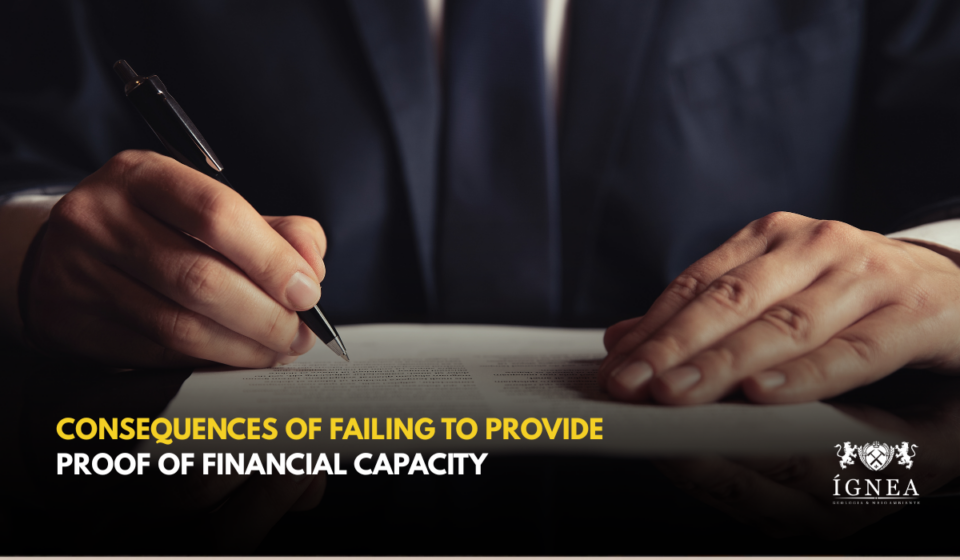
Proof of availability of funds (or financing commitment) is a structural financial requirement mandated by the National Mining Agency (ANM) at key stages of the mining cycle. Failing to demonstrate financial capacity can bring entire operations to a complete halt.
Below, we detail the main regulatory bottlenecks caused by the absence of this proof.
1. Halting the Application for a Development Concession
A declaration of resource availability is a mandatory component for the instruction of an application for a development concession. While the initial absence of this document may not trigger an immediate summary denial, it does prompt the ANM to issue requirements.
The Risk: If the miner fails to satisfy the requirements within the legal timeframe by demonstrating how the Plan of Economic Exploitation (PAE) will be funded, the application for exploitation will inevitably be denied. The project dies before it even begins.
2. Blocking M&A Transactions, Assignments, and Leases
Proof of financial capacity is strictly required for the recording of:
- Total assignment of mining exploitation rights.
- Total or partial lease of a development concession or mine claims.
- Transfer of rights due to corporate mergers, demergers, or consolidations.
- Transfer of rights through foreclosure of a pledge (asset repossession by creditors).
The practical consequence: Without financial proof under the name of the new beneficiary (assignee or lessee), the ANM will not process the recording. Legally, the transaction lacks validity against third parties, completely stalling the closing of the deal.
3. Disqualification from ANM Public Bidding Notices
For areas going to auction or subject to public bidding notices for assignment of use, the regulatory bar is high. Guidelines demand robust economic and financial credentials to ensure the company can support the implementation, operation, and, crucially, the decommissioning and closure of the mine. Without economic proof, the bidder is disqualified.
4. Environmental and Operational Hurdles (Hazardous Waste)
For projects operating with or generating hazardous waste, authorization and environmental licensing depend directly on the company’s financial health (proven through financial statements from the previous fiscal year and a bankruptcy certificate). The inability to demonstrate this financial backing prevents the issuance of operational licenses.
The Link to Reserves Resizing
There is a direct connection between financial capacity and a project’s reserves resizing, and this is where many miners miscalculate their long-term planning.
When a company submits a robust Final Exploration Report (RFP), it quantifies a specific mineral reserve. However, when applying for a Development Concession, the volume of that reserve must strictly align with the depth of the miner’s (or their investors’) financial capacity.
If the Plan of Economic Exploitation (PAE) outlines a large-scale operation to extract the entire reserve, the ANM will require proof of funding equivalent to that massive Capex. If the miner lacks this proven financial strength, the project will face official requirements.
The Regulatory Solution
To avoid the denial of the Application for Exploitation due to a lack of financial capacity, the strategic path forward is to perform a reserves resizing.
By downsizing the mining plan to a smaller scale (either by phasing the project or reducing the initial exploitable reserve), the Capex decreases. Consequently, the amount required as proof of financial capacity drops to a level the miner can readily prove and sustain, successfully safeguarding the asset’s concession.
AI-Generated Image