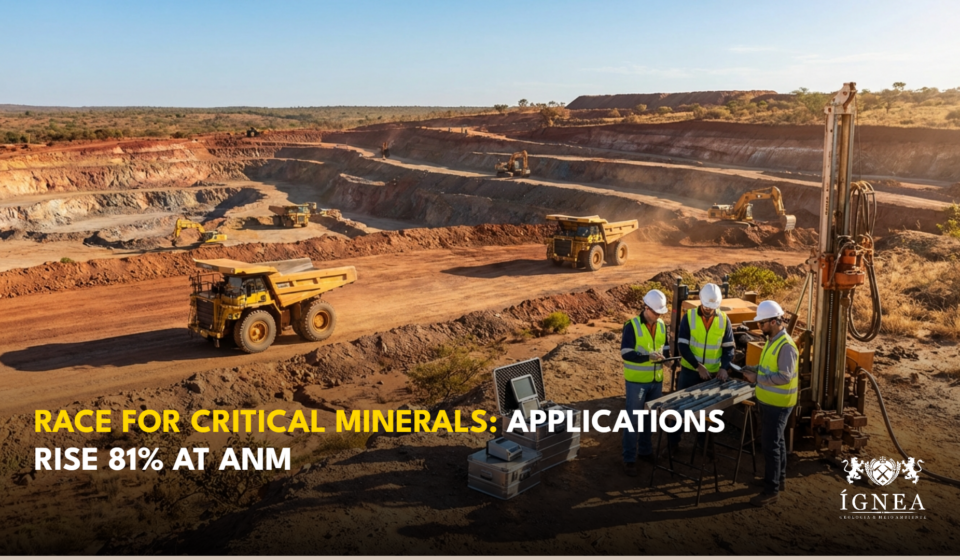
The global demand for essential minerals for the energy transition is reflecting directly on the Brazilian mining process. Data from the National Mining Agency (ANM) reveal an 81% increase in the volume of mineral exploration applications for critical minerals between the first and fourth quarters of 2025, totaling 9,319 requests throughout the year.
This significant increase, with a sharp peak at the end of 2025, highlights the market’s growing interest in Brazil’s strategic resources, such as lithium, nickel, graphite, and rare earths. However, the country still faces the challenge of converting its vast geological potential into large-scale production.
Global Reserves x Limited Production
Brazil holds a privileged geological position on the world stage. According to the ANM, the country concentrates relevant shares of global reserves for several critical inputs:
- Niobium: 94.1%
- Graphite: 22.4%
- Nickel: 16%
- Rare Earths: 9.1%
Despite this potential, the Brazilian share in world production remains modest. In the cases of lithium and rare earths, national production is residual, representing 0.002% and 0.03% of the global total, respectively.
This scenario becomes even more critical given the high market concentration. China, for example, controls about 82% of graphite production and 90% of rare earth processing capacity. Indonesia, in turn, dominates approximately 60% of the nickel supply.
Strategic and Diplomatic Scenario
The importance of critical minerals has transcended the economic sphere and become a diplomatic agenda. Cooperation agreements, such as the one recently signed between Brazil and India, signal the government’s intention to strengthen the country’s position in this production chain, seeking to attract investments not only for extraction but also for the processing and refining stages, where China currently holds hegemony.
While traditional mining continues to be a pillar of the Brazilian economy, accounting for 33% of the trade balance surplus in 2024, the race for critical minerals presents both a development opportunity and a structural challenge. Brazil’s capacity to transform its 9,319 new applications into operational mines will depend not only on geological potential but also on regulatory agility and the attraction of investments for the entire production chain.
Source: Folha de S. Paulo
📷Generated by AI