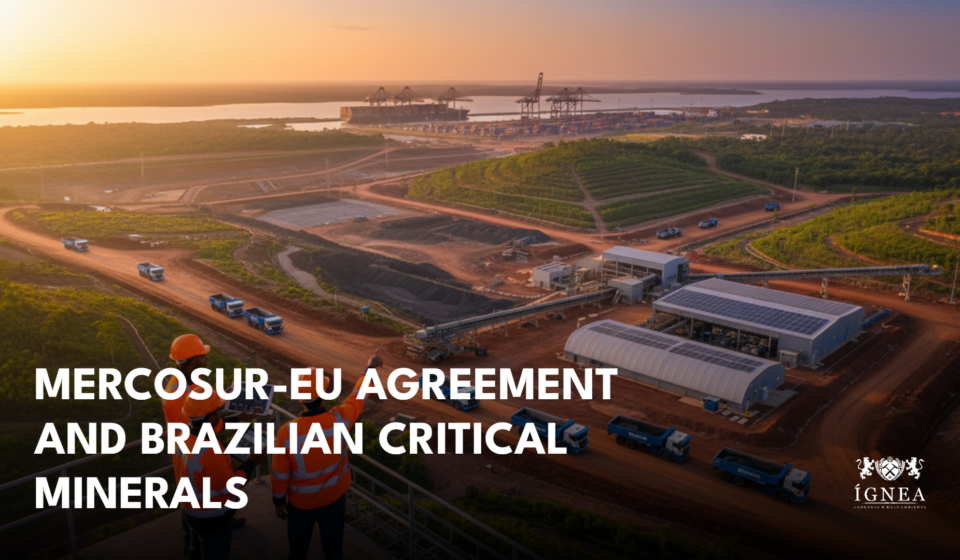
After more than 25 years of diplomatic negotiations, the member countries of the European Union preliminarily approved, this Friday (Jan 09), the trade agreement with Mercosur. The vote in the Committee of Permanent Representatives (Coreper), approved by a qualified majority, not only outlines the largest free trade zone in the world but also repositions Brazil as a key player in the geopolitics of natural resources.
For the mineral sector, this is not just news about tariffs; it is the consolidation of a strategy for autonomy and global energy transition.
The Geopolitical Context: Why Now?
The final acceleration towards the agreement’s approval occurs in a high-pressure scenario. The combination of protectionist tariffs imposed by the United States and Europe’s need to reduce dependence on China for raw materials has transformed Mercosur into a security priority for the European bloc.
European Commission President Ursula von der Leyen will travel to Paraguay next Monday (12) for the symbolic signing, sealing the commitment.
Critical Minerals: The Heart of the Agreement
The European Union has identified access to the South American bloc’s critical minerals as one of the treaty’s central pillars. Kristina Grutschreiber, the EU’s chief negotiator, was emphatic in stating that Europe “desperately needs” these raw materials to sustain its energy transition.
| Mineral | Primary Application | Brazil’s Position |
| Lithium | EV batteries and energy storage | 6th largest global reserve; expanding production |
| Niobium | High-strength steel alloys, superconductors | Global leader (90% of global production) |
| Graphite | Batteries, refractory materials, electrodes | Significant reserves; expansion potential |
| Nickel | Batteries, stainless steels, specialty alloys | Growing production; new deposits under exploration |
| Rare Earths | Permanent magnets, electronics, wind energy | Large reserves; low current production |
| Copper | Electrical conductors, renewable energy | Moderate production; potential in Carajás |
| Manganese | Batteries, steel production | Among the top global producers |
Flexibility and Value Addition
Unlike the original 2019 text, the renegotiation concluded between 2023 and 2024 brought a substantial victory for Brazilian industrial policy. The new text preserves Brazil’s right to implement policies for value addition in the mineral sector.
This means that Brazil retains the prerogative to apply restrictions or strategic export taxes to stimulate local processing, preventing the country from remaining merely an exporter of raw ore.
| Aspect | Pre-Agreement 2019 | 2024 Agreement |
| Export Tax | Prohibited | Permitted (up to 25% for EU) |
| Export Restrictions | Not provided for | Permitted to stimulate value addition |
| Industrial Policy | Limited | Preserved |
| Preferential Treatment | Not applicable | EU receives lower rate than other destinations |
Tariff Scenario and Market Access
The agreement provides for the progressive elimination of tariffs, creating a facilitated trade corridor. Although consolidated commodities like iron ore already enjoyed exemptions, the agreement offers legal security and competitive advantages for processed products and new energy transition minerals.
| Product | Current Tariff | Post-Agreement Tariff | Transition Period |
| Iron Ore | 0% | 0% | Already exempt |
| Ferro-alloys | 2.7% – 7% | 0% | Up to 10 years |
| Aluminum and products | 3% – 10% | 0% | Up to 10 years |
| Copper and products | 0% – 4.8% | 0% | Up to 10 years |
| Steel products | 0% – 10% | 0% | Up to 10 years* |
| Critical minerals | Variable | 0%** | Immediate to 10 years |
The advantages for Brazilian mining go beyond zero tariffs; they involve supply chain integration and the attraction of foreign direct investment focused on extraction and processing technology.
| Area | Benefit to Brazil |
| Market Diversification | Reduces dependence on Asian markets and offers an alternative to US-China trade tensions |
| Investment Attraction | Projected 1.49% increase in foreign investment flow; European interest in sustainable mining projects |
| Value Addition | Flexibility to impose export restrictions and taxes stimulates local processing of critical minerals |
| Technology Transfer | Partnerships in sustainable mining, processing techniques, and energy transition technologies |
| Green Steel | 85% renewable power matrix positions Brazil as a provider of low-carbon steel products |
| Preferential Access | Elimination of 100% of EU industrial tariffs within 10 years; advantage over competitors without an agreement |
| Institutional Cooperation | Bilateral dialogues on responsible mining, renewable energy, and biodiversity |
| Government Procurement | Brazilian companies will be able to participate in European tenders on equal terms |
The Sustainability Challenge (CRMA)
The agreement is intrinsically linked to the Critical Raw Materials Act (CRMA) and new European sustainability guidelines. Brazilian mining companies will face greater scrutiny regarding supply chain transparency and ESG certifications.
The European market demands “clean” minerals. Compliance with these requirements will not be optional, but rather the passport for entry into this market.
| Requirement | Implication | Recommended Action |
| Supply chain traceability | Need to document origin and extraction process | Implement tracking and certification systems |
| Commitment to zero deforestation by 2030 | Linkage to the Paris Agreement as an essential element | Adjust operations in sensitive areas |
| Responsible mining | European environmental and social standards | Adopt international certifications (e.g., IRMA) |
| Specific rules of origin for iron and steel | Differentiated criteria for steel products | Ensure compliance with rules of origin requirements |
| Environmental due diligence | Conformity with European Green Deal regulations | Invest in low-carbon processes |
Next Steps
With Coreper’s approval, the path is open, but not concluded. The formal signing on Monday (12) will initiate the ratification process by the European Parliament, where political battles—especially with the French agricultural wing—are still expected.
| Phase | Description | Status/Timeline |
| Conclusion of Negotiations | Announcement of the final text in Montevideo | ✓ December 2024 |
| Safeguards Approval | European Parliament approves agricultural protection mechanisms | ✓ 12/16/2025 |
| Member State Approval | Qualified majority vote in Coreper | ✓ 01/09/2026 |
| Formal Signing | Ceremony in Paraguay with Ursula von der Leyen | 01/12/2026 |
| EU Parliament Ratification | Plenary vote – expected to be tight | Coming months |
| Mercosur Ratification | Approval by national congresses | 2026 |
| Provisional Entry into Force | Trade portion may enter into force after bilateral ratification | 2026 |
| Tariff Phase-out | Progressive elimination of industrial tariffs | Up to 10 years after entry into force |
Conclusion
The approval of the Mercosur-EU Agreement marks a historic moment. For Brazilian mining, the treaty offers a double benefit: it guarantees a market for our critical minerals at a time of high global demand and, crucially, protects our capacity to industrialize these riches on national soil.
📷 Generated by AI
Source: Brasil Mineral