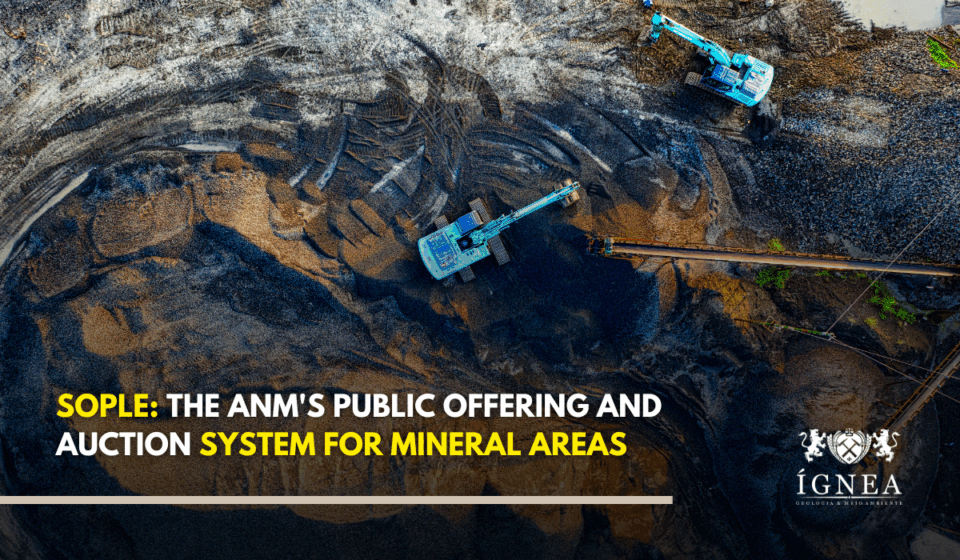
The System of Public Offering and Auction of Areas (SOPLE) represents the regulatory mechanism of the National Mining Agency (ANM) for making unencumbered areas available to the productive sector. This electronic system confers transparency and competitiveness on the acquisition of new mining rights in Brazil. SOPLE adopts the highest financial value as the main tie-breaking criterion, transforming what were previously relinquished or extinct areas into investment opportunities.
The Public Offering and Auction procedure is intended for areas that have been released by an administrative act, as provided for in Mining Law (Decree-Law No. 227/1967). The management and indication of these areas for the tender are coordinated by the Superintendence of Mineral Planning and Availability of Areas (SOD) of the ANM. The SOD, through the Area Availability Coordination, is responsible for managing the entire process, from defining the rules to managing the SOPLE system itself.
Access Requirements and Initial Procedure
To participate in the Public Offering process, the interested party must meet essential prerequisites that ensure the seriousness of the tender:
- Prior Registration: Registration is mandatory both in the ANM’s Digital Protocol System and on the SOPLE platform.
- Access and Authentication: Access to SOPLE is carried out through the Federal Government’s single login, utilizing a digital certificate (e-CPF or e-CNPJ), which ensures the proponent’s identity.
SOPLE has a “public opportunities portal” where the edicts and available areas are disclosed. The first step is the Expression of Interest, where the user registers their interest in the desired area, respecting the maximum limit defined in the Edict. It is important to emphasize that the deadline for this expression is a critical point, being 60 days from the publication of the Edict in the Official Gazette of the Union (D.O.U.).
Tender Phases and Tie-Breaking Criteria
The SOPLE selection process is structured in clear phases, which ensure objectivity in defining the winning proponent:
| Phase | Procedure | Defining Criterion |
| 1. Expression of Interest | Registration of interest in the area. | Deadline of 60 days from the Edict’s publication. |
| 2. Result Disclosure | Publication of interested parties after the final deadline. | Defines whether the process will proceed to Ratification (single interested party) or Auction (multiple interested parties). |
| 3. Tie-Breaking | Electronic Auction | The priority criterion is the highest financial proposal presented. |
In the event of only one Expression of Interest, the proponent awaits the ratification of the result and is notified to protocol the application for the mining title document (exploration, mining development, or prospecting, as per the Edict).
However, if there are multiple interested parties for the same area, the process advances to the financial proposal tie-breaking stage. Although the auction is the standard criterion, the Edict may provide for the use of objective criteria of a technical, economic, and social nature for tie-breaking in specific situations, such as in cases of contiguous polygons.
Consequences of Non-Compliance and Responsibility
As this is a public tender, SOPLE edicts follow the guidelines of Law No. 8.666/1993. The proponent who wins the auction and fails to make the full payment of the bid price within the fixed deadline immediately loses the right of priority over the area. Furthermore, the winner is subject to applicable sanctions proposed by the ANM. The Area Availability Coordination of the SOD has the authority to exercise control and propose sanctions in case of default.
It is imperative that interested parties in SOPLE pay attention to the guidelines of each Edict, as the non-compliance with any obligation within the established deadline can invalidate the entire process, resulting in the loss of the opportunity to acquire the mining right.
Attention: The deadlines and sanctions cited in this text are factual based on the legislation and current procedures. However, specific values and regulations for each Edict must be confirmed on the date of the tender’s publication.
📷Canva/Edition by ÍGNEABR