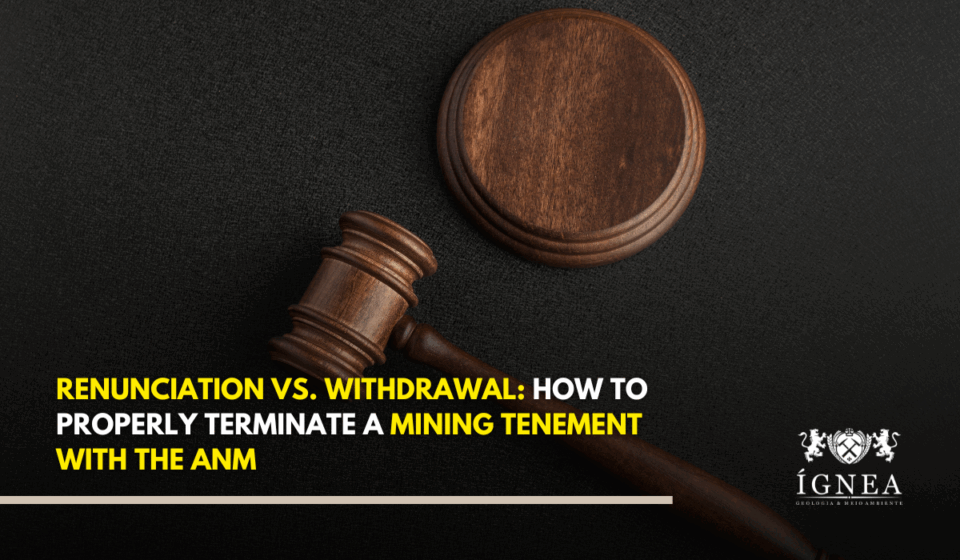
In the management of mining rights, it’s common for mining companies and professionals to face situations where they need to terminate an ongoing process or relinquish an already granted title. In these cases, understanding the difference between renunciation and withdrawal is essential to make the correct decision and avoid legal complications with the National Mining Agency (ANM).
This article clearly and objectively explains the main characteristics, differences, and practical implications of these two administrative institutes, which are fundamental for the formal termination of mining procedures.
What is Withdrawal?
Withdrawal refers to the voluntary retraction of a request still in progress, meaning it has not yet generated a mining title (such as a Research Permit, License Registration, Placer Mining Permit, among others).
This action can be motivated by factors such as technical unfeasibility, overlap with other processes, strategic reevaluation of the area, or an error in filling out the request. Withdrawal avoids the continuation of the process and the eventual generation of future costs for the titleholder.
Important: Upon withdrawing, the interested party does not assume subsequent responsibilities for that request, provided there are no environmental damages or non-compliance with other legal obligations.
How to request it?
Withdrawal must be formalized exclusively through the ANM’s Digital Protocol, by accessing the “Protocol by Process Number” option and choosing the specific withdrawal service according to the type of request (research, licensing, extraction, etc.).
And what is Renunciation?
Renunciation, on the other hand, applies to situations where the mining tenement has already been granted — as in the case of a Research Permit, Mining Concession, or Extraction Registration — and the titleholder wishes to definitively terminate the right, without transferring it to third parties.
Renunciation is irrevocable and irreversible, and its effect is the extinction of the mining right in the ANM’s database. However, its formalization must follow specific normative criteria, such as the submission of a technical report with the history of the area and the mine’s situation, when required.
Example: A Mining Concession titleholder who no longer wishes to operate the mine must submit a renunciation request with a technical report as provided in Articles 58 of the Mining Code and 51 of Decree No. 9,406/2018.
How to request it?
Renunciation must also be filed through the ANM’s Digital Protocol, by choosing the “Request Renunciation” service according to the type of granted tenement.
Comparative Table: Renunciation vs. Withdrawal
| Aspect | Withdrawal | Renunciation |
| Process Phase | Request under analysis | Tenement already granted by the ANM |
| Legal Effect | Extinction of the request, without tenement generation | Formal extinction of the mining right |
| Report Required | No | Yes, for mining (lavra) and grant cases |
| Normative Basis | Law No. 9,784/1999 (Administrative Procedure) | Arts. 22 and 58 of the Mining Code, Dec. 9,406/2018 |
| Where to Request | Digital Protocol > “Protocol by Process Number” | Digital Protocol > “Request Renunciation” |
Attention to Post-Renunciation Obligations
Renouncing a tenement does not exempt the titleholder from prior responsibilities. Obligations such as environmental liabilities, pending reports, or non-compliance with conditions may be charged even after the renunciation protocol. Therefore, it is advisable to seek specialized legal and technical advice to assess the risks before formalizing the request.
Conclusion
Both renunciation and withdrawal are legitimate instruments for terminating mining processes and rights, and they are part of good regulatory governance in the sector. The important thing is to correctly identify the phase of the process and follow the ANM’s administrative procedures transparently and in accordance with current regulations.
Whichever path you choose, the support of a qualified technical and legal team can prevent penalties, notifications, and rework — and ensure your company’s legal certainty with the National Mining Agency.
Canva/Edition by ÍGNEABR