The filing campaign for the Annual Mining Report (RAL) base year 2025 has already begun. Although the RALWeb platform maintains its known interface, some changes have been introduced for this year’s filing.
This technical guide unifies the system navigation manual with the regulatory requirements in force for 2026.
1. Access and Authentication
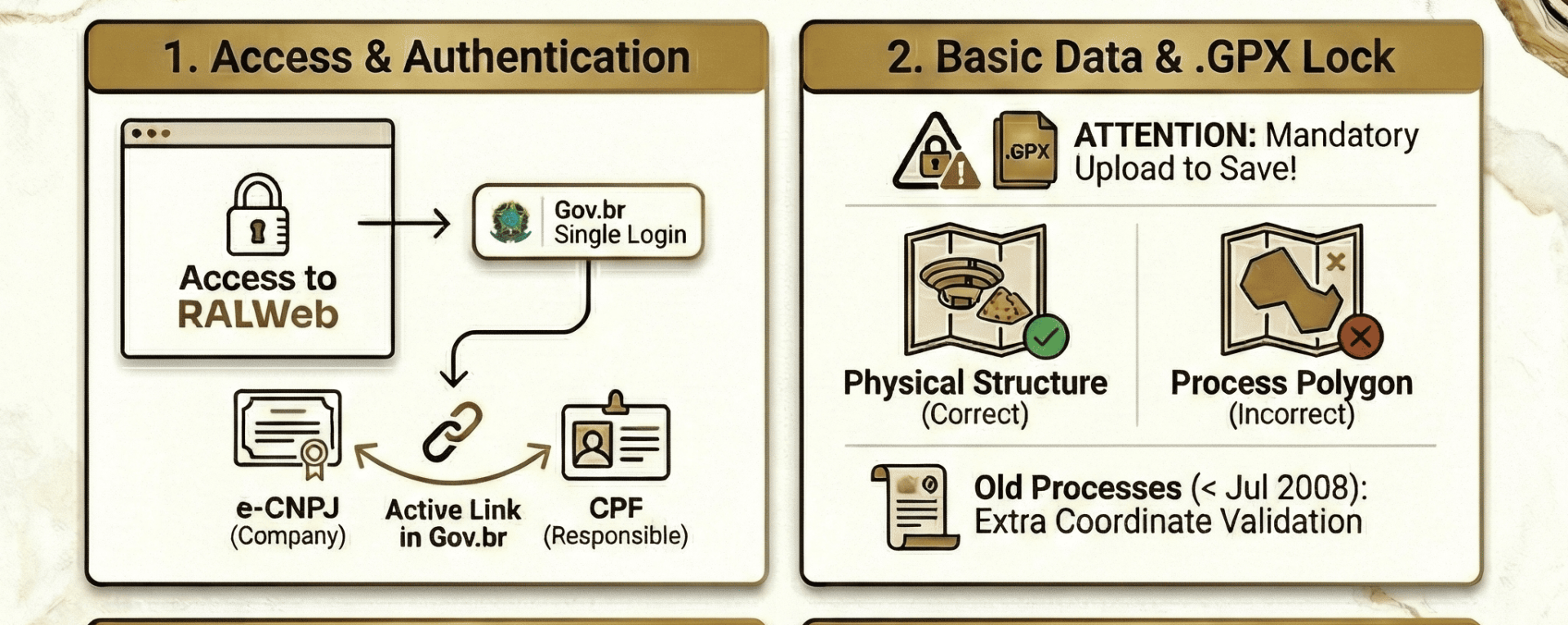
The first step is accessing RALWeb. It is performed exclusively through the Gov.br Single Login. Ensure that the digital certificate (e-CNPJ) of the titleholder company is active and linked to the CPF of the technical manager or declarant. Without this link on Gov.br, the system will not enable the option to file on behalf of the titleholder.
2. Basic Data and the Polygon Lock
When starting a new declaration (whether for Mine, Plant, Mineral Water, or Structures), the system will require filling out the “Basic Data” tab.
Attention: It is not possible to save the basic data without uploading the .gpx file of the structure’s polygon.
- What to send: The file must contain the drawing of the physical structure (mine pit, plant layout, pile, or dam) and not the polygon of the mining process.
- Old Processes: For processes started before July 2008, the system will require an extra validation of the area polygon coordinates.
3. Mining and Processing: Inventory and Sales Rules
In the production and commercialization tabs, two new data consistency rules are active for the base year 2025:
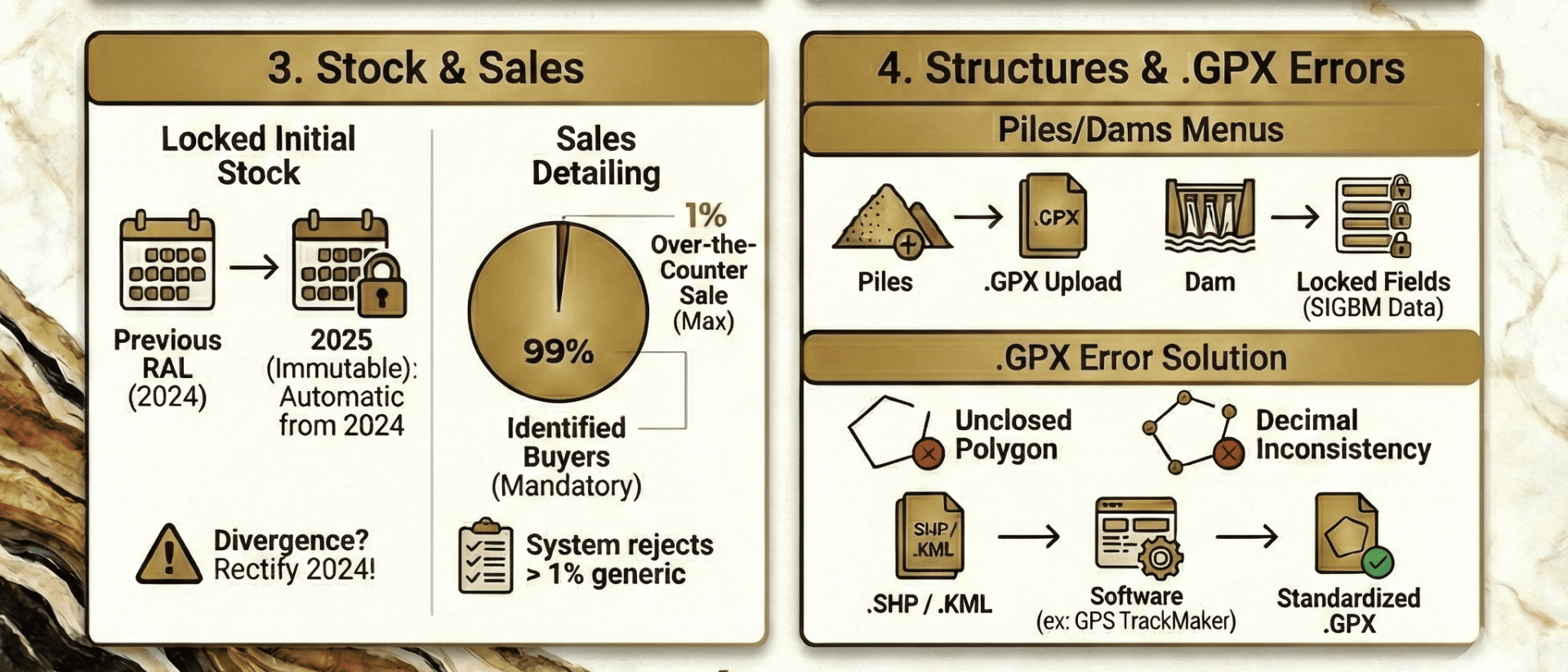
- Locked Opening Stock: The “Opening Stock” field will come automatically filled by the system, replicating exactly the final balance declared in the previous RAL (2024). This field is immutable. If there is a discrepancy, it will be necessary to rectify the previous year before proceeding.
- Sales Detailing: The ANM has increased rigor in traceability. It is mandatory to declare and identify buyers for at least 99% of the traded volume. The system will not accept declarations with generic “over-the-counter sales” volumes exceeding 1%.
4. Structures Menu: Piles and Dams
The system has segregated the registration of waste and tailings disposal structures into specific menus.
- Piles Menu: It is necessary to register the pile, link it to the source mine, and insert the physical-chemical characterization of the deposited material. Uploading the pile polygon (.gpx) is mandatory.
- Dams Menu: The system automatically imports data from SIGBM (Integrated Dam Safety Management System). The “Basic Data” fields will come locked according to the registration in SIGBM. If there is a discrepancy (e.g., height or construction method), the change must be made in SIGBM, not in RAL.
5. Troubleshooting .GPX File Errors
The most common error preventing the saving of the declaration is the failure to upload the polygon. The system rejects files if:
- The polygon is not closed (the last point does not coincide with the first).
- There is inconsistency in the number of decimal places between vertices (e.g., one point with 6 places and another with 7).
Technical Recommendation: Use software like GPS TrackMaker to import your .shp or .kml file and export it again in .gpx to standardize the vertices.
Final Deadlines for Submission
The system will close for receipt according to the title category:
- By March 15, 2026: For mine manifests, Mining Lease ordinances, Small-Scale Mining Permits, Mineral Extraction Registries, Experimental mining licenses, and Mineral Licensing with approved PAE.
- By March 31, 2026: Exclusive for Mineral Licensing registrations without approved PAE.
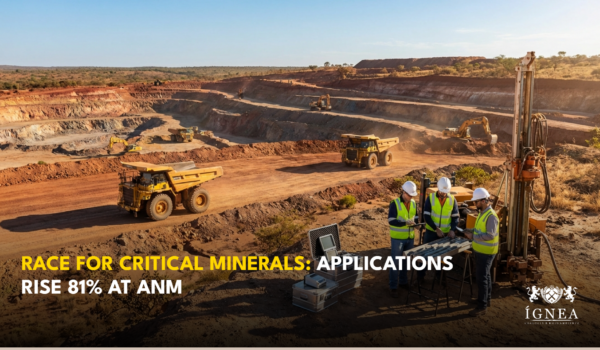
📷Generated by AI