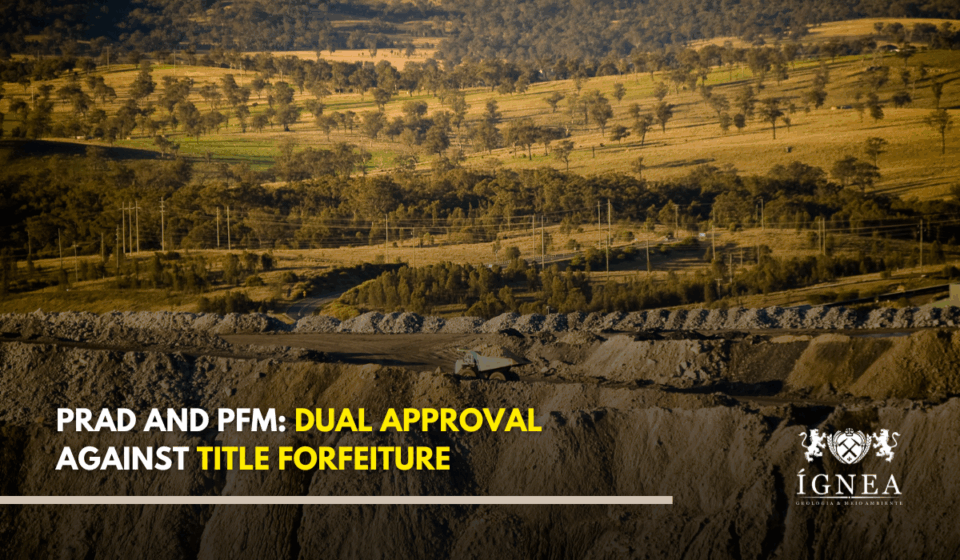
The environmental responsibility in mining is non-negotiable and persists until the end of the venture’s life cycle. Fulfillment of this obligation requires the management of two legal instruments that operate in an articulated manner: the Mine Closure Plan (PFM), required by the National Mining Agency (ANM), and the Degraded Area Recovery Plan (PRAD), required by the environmental agency. The breach of the rules associated with these plans is the infringement that, in effect, threatens the mining title document.
1. Dual Approval: PFM (ANM) vs. PRAD (Environmental Authority)
The law establishes that the concessionaire is obliged to practice environmental recovery acts. To this end, the management of the closure must contemplate dual approval, which is the intersection between the granting control and environmental control:
- PFM (Mine Closure Plan): This is the mandatory document that integrates the Plan of Economic Exploitation (PAE). It is submitted to the ANM and has the main objective of ensuring that the venture’s closure is safe and compatible with the area’s final destination. The titleholder’s obligations persist until the approval of the mine closure by the Agency.
- PRAD (Degraded Area Recovery Plan): This is the environmental document, presented to the Environmental Licensing Authority along with the EIA/RIMA. The PRAD details the measures for the return of the degraded site to a form of utilization compatible with a pre-established land-use plan.
The dual approval of the PFM by the ANM and the Environmental Licensing Authority is the condition for the concessionaire to effectively comply with the recovery obligations. The coordination between the ANM and the SISNAMA bodies, including IBAMA, acts as an articulated oversight system that covers everything from dam safety to waste management.
2. Technical Content and Post-Closure Monitoring
The concept of recovery and rehabilitation is widely addressed in the Mining Regulatory Standards (NRM-21), which define the scope and content of the project. Recovery must be comprehensive, applying to all areas used by the activity, including:
- Explored Areas: Any area used by geological exploration, if not integrated into the future mine.
- Mined and Easement Areas: The mine area, storage of waste rock, minerals, and tailings, and access roads.
- Impacted Areas: Any area with alteration in biotic and abiotic factors caused by mining.
The PFM must mandatorily include detailed Plans that prove the rehabilitation capability of the area. These technical plans go beyond revegetation and minimally encompass: Geotechnical Stability, Erosion Control, Drainage, and Landscape and Topographic Adequacy.
A point of attention is Post-Closure Monitoring. The PFM must foresee the continuous monitoring and follow-up of waste rock and tailings disposal systems, the geotechnical stability of the mined and easement areas, the behavior of the aquifer, and water drainage. The recovery of the degraded environment must also include mine closure and the decommissioning of all installations, including tailings dams.
3. The Maximum Risk: Group IV Infraction and Title Forfeiture
The point of greatest legal vulnerability for the miner occurs at the closure of operations. The law establishes severe sanctions for the non-compliance with recovery obligations, the most serious being the Group IV Infraction (ANM Resolution No. 122/2022).
The following constitute Group IV Infractions, subject to revocation:
- Failure to carry out the recovery of the degraded environment, which includes mine closure and the decommissioning of all installations, including tailings dams.
- Failure to comply with the obligations and responsibilities until the final approval of the mine closure.
- Failure to carry out the monitoring and follow-up of waste rock and tailings disposal systems after closure.
The Group IV Infraction is the basis for the institution of an administrative proceeding for forfeiture of the title. Furthermore, the concessionaire is subject to fines. The omission in communicating the temporary suspension of the development work also constitutes a serious infraction, subject to fine. Even in case of renunciation of the title, the ANM will take the necessary measures to ensure the adequate execution of the PFM and the application of applicable sanctions. The PFM/PRAD is, therefore, the miner’s legal defense against the maximum penalty.
Read our articles on: