On Thursday, January 29, 2026, the Ministry of Labor and Employment (MTE) published Ordinance No. 105, which brings significant changes to Regulatory Standard No. 22 (NR-22), the main regulatory framework for Occupational Health and Safety in Brazilian Mining.
The new standard, which is already in force, not only updates operational procedures in open-pit and underground mines but also approves Annex V, which specifically deals with exposure to mineral dust.
Below are the main impacts of the new Ordinance on mining and processing operations.
1. Annex V: Rigorous Control of Mineral Dust and Silica
The most impactful change is the approval of Annex V of NR-22. It establishes strict guidelines for the assessment and control of occupational exposure to mineral dust. The main highlights are:
- Provisional Limit for Silica: Art. 4 of the Ordinance establishes the Occupational Exposure Limit (OEL) of 0.05 ppm for “Crystalline Silica” and “Cristobalite Silica,” until NR-9 defines the final standard.
- OEL Adjustment for Extended Shifts: The new annex requires the recalculation and reduction of the OEL for shifts exceeding 8 hours per day or 40 hours per week.
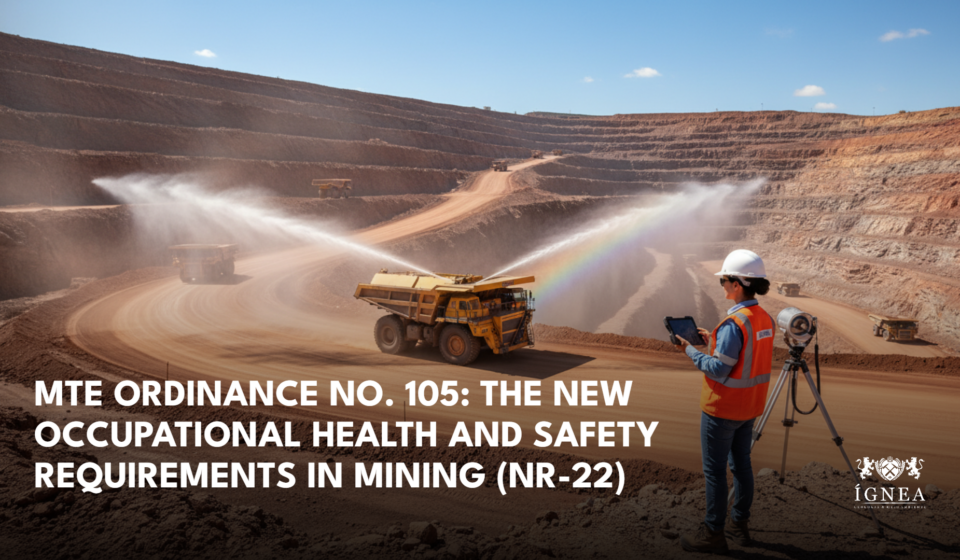
- Mandatory Humidification: Drilling, cutting, blasting, loading, and crushing operations must be performed using humidified processes. Compressed air ventilation is expressly prohibited, except in emergencies.
2. Heat Exposure Management (Alignment with NR-9)
Item 22.15 of NR-22 has been reformulated. Now, heat exposure in mining is strictly governed by the guidelines of Annex III of NR-9. Another change for open-pit mines is the new requirement that the company must provide access to places—including natural ones—that are thermally milder, to allow for the thermal recovery of workers.
3. Mining Dams: Restrictions in the Self-Rescue Zone (ZAS)
The Ordinance reinforces the alignment of NR-22 with the National Dam Safety Policy (PNSB) and ANM standards. It is expressly forbidden for any worker to remain in the ZAS in situations of grave and imminent risk. Under normal conditions, access is restricted only to essential personnel for operation, maintenance, and decharacterization/reinforcement works on the structure.
4. Rock Blasting and Operational Safety
The standard updates procedures for mining, including:
- Underground Explosives: Underground storage is limited to the quantity necessary for a maximum of 5 days of work.
- Underground Infrastructure: Every underground mine is now required to have at least two access routes to the surface (one main and one emergency), separated and interconnected.
- Mechanization and Hoisting: Equipment with a skip must have a safety anti-rollback brake, a limit switch, and protection against unauthorized access to the shaft.
Compliance Deadlines
Although the Ordinance entered into force on the date of its publication, Art. 9 establishes a compliance schedule for existing structures, with deadlines ranging from 3 to 5 years for certain items, such as the climate control of self-propelled machines and the removal of facilities from the safety perimeter of stockpiles. Most new rules, however, apply immediately.
This analysis highlights the points of greatest impact in the new standard. However, MTE Ordinance No. 105/2026 is extensive and details dozens of changes in equipment, electrical installations, and operational procedures. It is recommended to read the full text of the ordinance to understand all new requirements and ensure the correct compliance of each work front.
📷Generated by AI