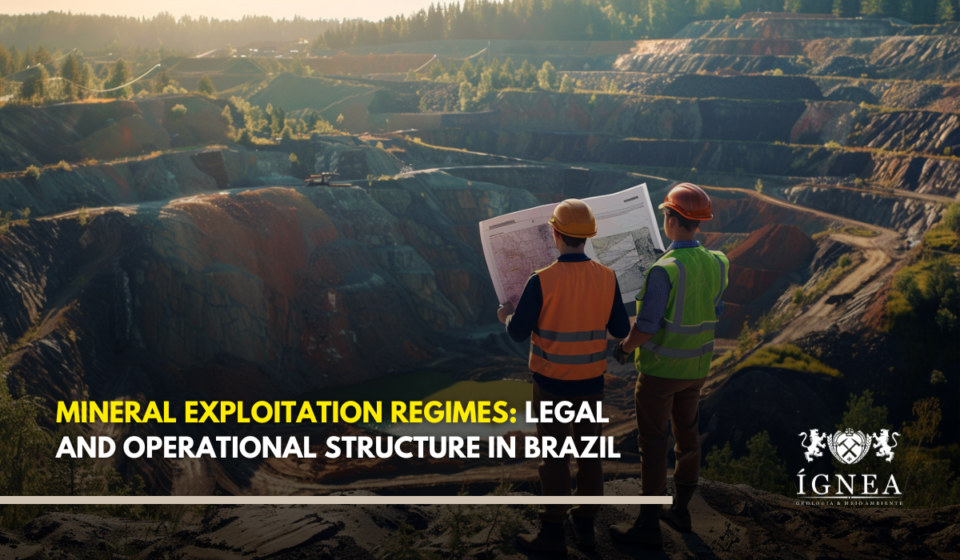
The Brazilian mining legal framework establishes clear guidelines on how mineral resources can be exploited. According to the Constitution, land ownership is distinct from mineral resource ownership, which belongs to the Union.
For an individual or company to carry out extraction, it is necessary to obtain a specific title granted by the National Mining Agency (ANM). The choice of the mineral exploitation regime is not optional; it depends on the substance, purpose, applicant, and area. The mistaken application of a regime results in the denial of applications or the nullity of titles, creating legal uncertainty for the enterprise.
Comparison of Exploitation Regimes
For a clear overview, the table below summarizes the main regimes under ANM’s management:
| Regime | Substances Covered | Title Granted | Eligible Applicant |
| Authorization and Concession | Most substances (Metals, etc.) | Exploration Permit / Mining Concession Decree | Brazilians, sole proprietorships, or companies. |
| Licensing | Construction materials. | License Registration | Landowner or with their consent. |
| Small–Scale Mining Permit | “Garimpáveis” minerals (Gold, etc.). | Small-Scale Mining Permit | Individuals, cooperatives, or sole proprietorships. |
| Extraction Registration | Construction materials (public works). | Extraction Registration | Public administration bodies. |
1. Authorization and Concession Regime
This is the full-rite regime, applied to high-value substances or those requiring complex geological studies. Its features are:
- Exploration Phase: The interested party obtains an Exploration Permit to conduct fieldwork and deposit quantification. At the end, a Final Exploration Report is submitted.
- Mining Phase: With the report approved, the titleholder has the right to request a Mining Concession. Commercial extraction is only permitted after the issuance of the Mining Concession Decree.
- Legal Security: It is the regime that offers the greatest robustness for long-term investments.
2. Licensing Regime
With a simplified administrative rite, it is specifically aimed at the infrastructure and civil construction sector. Its main points are:
- Focus: Substances such as sand, crushed stone, and clay.
- Procedure: It depends on a municipal license, which must be registered with the ANM.
- Essential Condition: The applicant must be the landowner or have formal authorization from them to apply for the title.
3. Small-Scale Mining Permit (PLG)
This is intended for the immediate exploitation of mineral deposits that allow for extraction using simpler methods, without the need for in-depth geological studies.
- Application: Restricted to specific substances (such as gold and diamond) and with area limitations (50 ha for individuals).
- Characteristics: The title has a precarious and temporary nature but allows for a quick start of operations.
- Ownership: Can be requested by individuals, small-scale mining cooperatives, or sole proprietorships.
4. Extraction Registration
This regime has a strictly institutional character and does not apply to private parties.
- Purpose: Extraction of construction materials for direct use in public works.
- Applicant: Exclusive to public administration bodies (Union, States, Municipalities).
- Main Restriction: The law strictly prohibits the commercialization of the ore extracted under this regime.
Conclusion
Strategically defining the mineral exploitation regime is the first step toward a project’s viability. Non-compliance with the rules can lead to financial losses and forfeiture.
Given the complexity of the system, Ígnea provides specialized advisory for mineral asset management, ensuring that entrepreneurs select the appropriate regime and maintain compliance in all phases of the process.
📷Generated by IA