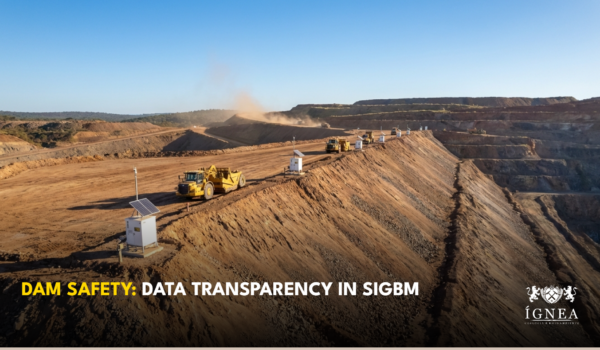
If the physical stability of a dam is what guarantees the tranquility of daily operations, its response capacity to unforeseen events is what defines the resilience of the mining company. In the regulatory calendar of the National Mining Agency (ANM), after the DCE cycle in March, attention turns to the Declaration of Conformity and Operability (DCO), the document that validates the effectiveness of the Emergency Action Plan (PAEBM).
DCE vs. DCO: Essential Distinctions
Although both are fundamental for compliance in the SIGBM, they have distinct natures and schedules. Understanding this difference is the first step toward efficient risk management.
| Characteristic | DCE (Declaration of Stability Condition) | DCO (Declaration of Conformity and Operability) |
| Main Focus | Safety and physical and structural stability of the dam. | Conformity and readiness of the Emergency Action Plan (PAEBM). |
| Periodicity | Biannual (March and September Campaigns). | Annual (June Campaign). |
| Objective | To certify that the structure is not at risk of rupture. | To certify that the company knows how to act in the event of an accident. |
The July “Trigger”: The Consequences of Default
Unlike other administrative deadlines that allow subsequent rectifications with light fines, the DCO has an automated punishment system. If the document is not delivered by the final deadline in June, or if it is submitted certifying the non-conformity of the PAEBM, the ANM system triggers immediate protocols:
- Automatic Assessment: Generated right in the first minute of July 1st.
- Immediate Embargo: The structure is interdicted in the system, halting the associated operation until the situation is regularized.
This rigidity reinforces that, for the regulatory agency, an inoperative emergency plan is as critical as a structural failure.
Technical Responsibility and the Independence Rule
To sign the DCO, the responsible professional must be legally qualified by the CONFEA/CREA system and hold a specific Technical Responsibility Annotation (ART) for the design, construction, operation, or maintenance of dams.
However, the great complexity of the DCO lies in the Segregation of Duties, reinforced by regulatory updates:
- The technical responsible for issuing the DCO must necessarily be an independent figure. They cannot have participated in the preparation of the PAEBM nor the hypothetical dam break study. Furthermore, they must not have technical, commercial, or corporate ties with the company that prepared these original documents.
This “third-party” requirement aims to ensure that the operability of the emergency plan is tested by an impartial eye, free from preparation biases, ensuring that the training, sound systems, and escape routes actually work in practice.
Planning and Legal Certainty
The regularity of the DCO in June is what separates preventive management from an operation under real risk of administrative interdiction. Ensuring that the PAEBM is functional and validated by an independent external analysis is what sustains the legal certainty of the unit. Anticipating the organization of this cycle, especially in hiring impartial professionals for the technical signature, is the most efficient strategy to avoid the automatic assessments of July and ensure that the mine’s response protocols are, in fact, ready for any scenario.
📷Generated by AI