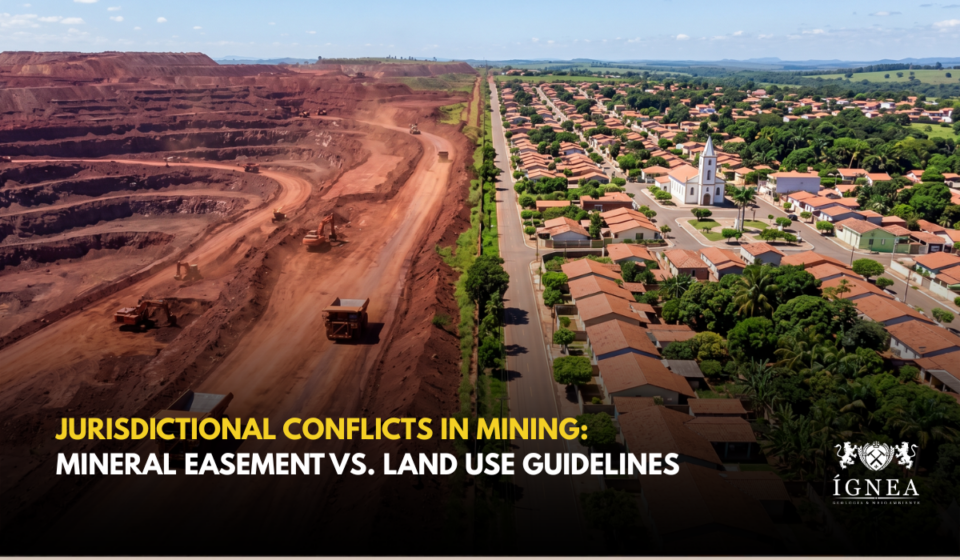
The granting of a mining title at the federal level confers the right to the exploitation of the subsoil, but the practical execution of the project depends directly on regularizing the surface.
In this scenario, two legal instruments from different levels of government inevitably intersect to make any project viable: the Land Use Certificate (municipal scope) and the Mineral Easement (federal scope).
Essential Definitions
- Land Use Certificate: This is the administrative certificate issued by the City Hall that attests to the compliance of the mining activity with the Master Plan and local zoning laws. It validates whether the municipality allows industrial or extractive activities at those specific geographic coordinates.
- Mineral Easement: This is a right in rem of use over real property owned by another, instituted by the National Mining Agency (ANM). It authorizes the mining titleholder to occupy the land necessary for the installation of the mine’s support infrastructure (such as access roads, transmission lines, treatment plants, and waste dumps or tailings piles), extending both to the real estate where the deposit is located and to neighboring lands affected by the enterprise.
The Practical Relationship
The connection between the Land Use Certificate and the Mineral Easement lies in the fact that both address surface regularization, but from different and complementary perspectives: the public ordering of land and private property rights.
The Mineral Easement resolves the conflict of interest with the landowner. By issuing the Easement Certificate, the ANM declares the public utility of that area, providing the technical basis for the miner to obtain the judicial vesting of possession if amicable negotiations fail.
However, federal mining rights do not absolutely override municipal autonomy to regulate land use within its own jurisdiction. This is precisely where these instruments connect:
[ANM / Court] -> Mineral Easement -> Guarantees physical access to the land (Relationship with the Owner)
+
[City Hall] -> Land Use -> Guarantees territorial legality (Relationship with the Municipality)
=
[Environmental Agency] -> Operating License -> (Project Made Viable)
It is of no use for a miner to establish a mineral easement and obtain the judicial right to occupy the land if the city hall denies the Land Use Certificate on the grounds that the area has been designated as a residential urban expansion zone or a local historical protection zone.
Since the state environmental agency requires the municipal Land Use Certificate as a mandatory prerequisite to issue Installation and Operating Licenses, a municipal denial effectively nullifies the impact of the federal easement.
Conclusion
The two instruments operate in a regime of interdependence: while the Mineral Easement secures the physical space and removes the landowner’s veto, the Land Use Certificate validates the compatibility of the mine with regional development.
📷 AI-Generated Image