Technical Analysis: Ranking of Published Exploration Permits in 2025
The publication of an Exploration Permit represents a fundamental milestone in the mining proceeding, formalizing the titleholder’s right of priority to explore the geological potential of a given area. The analysis of consolidated data for 2025, which points to a total of 7,334 permits published nationwide, offers a clear overview of the dynamism and geographical distribution of mineral exploration activity in Brazil.
The ranking of permits by the National Mining Agency’s (ANM) Management Units reveals trends and confirms the mineral potential of certain regions, serving as a strategic tool for decision-making by investors and industry professionals.
Concentration and Leadership: The MG-BA-GO Axis
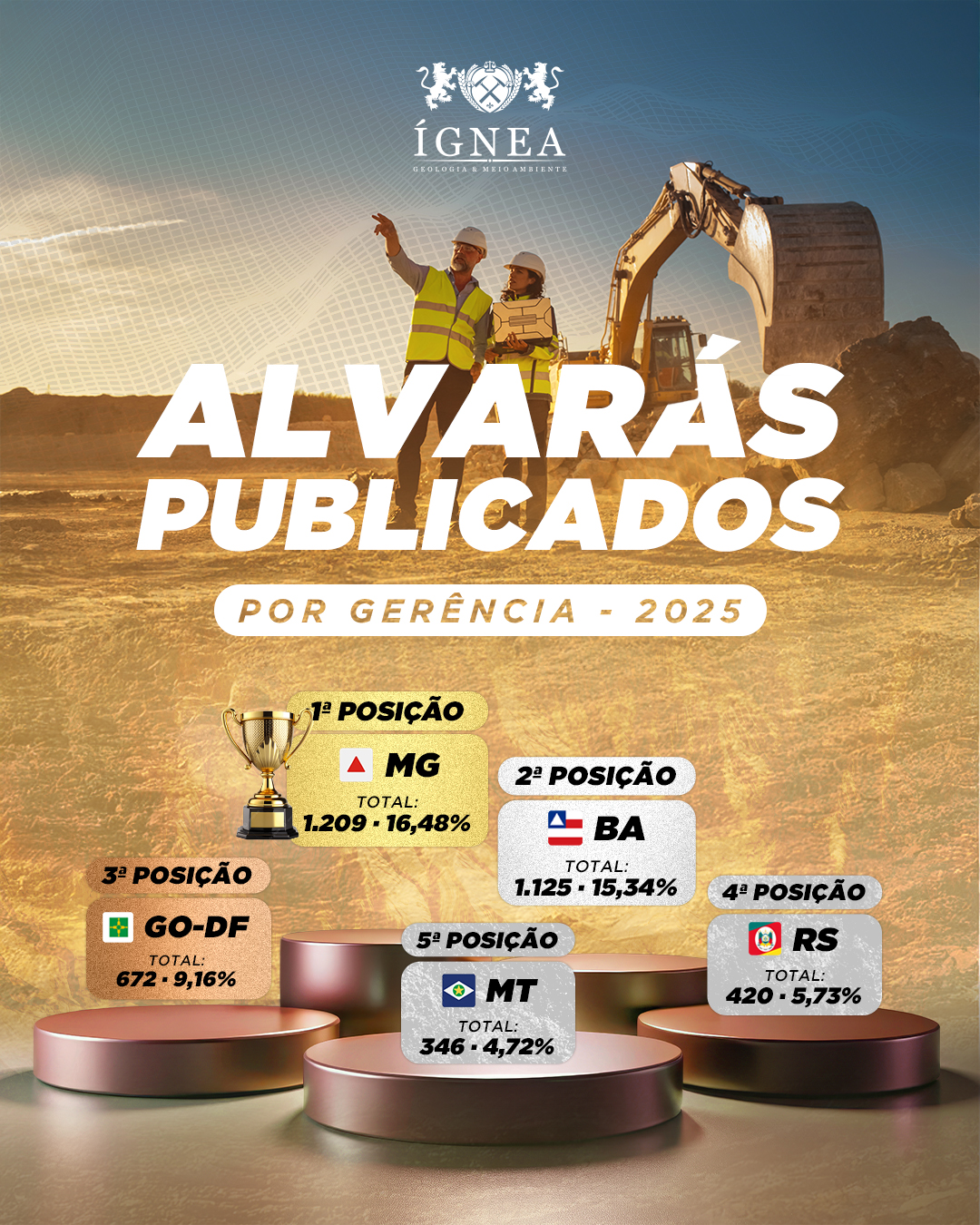
The data analysis shows a remarkable concentration of permits in the top three positions. Minas Gerais (MG), Bahia (BA), and Goiás/Distrito Federal (GO-DF) together account for 3,006 permits, which corresponds to 40.98% of the national total. If we expand the analysis to the Top 5, including Rio Grande do Sul (RS) and Mato Grosso (MT), this percentage rises to 51.43%, indicating that more than half of all new exploration rights are concentrated in just five federal units.
- Minas Gerais (1st Position – 1,209 permits | 16.48%): The leadership of Minas Gerais is not surprising and reaffirms its position as the country’s main mining state. Its geological diversity, highlighted by the Quadrilátero Ferrífero (Quadferr iron ore district) and the Rio das Velhas Gold Province, continues to attract massive investment. The published permits reflect not only the continued interest in metallic commodities (iron, gold) but also in a wide range of construction materials, ornamental rocks, and industrial minerals.
- Bahia (2nd Position – 1,125 permits | 15.34%): Bahia has consolidated itself as a nationally relevant mineral exploration hub. The state’s geology is extremely favorable, hosting deposits of vanadium, uranium, nickel, copper, gold, and a vast array of ornamental rocks. The significant number of permits indicates a strong movement towards diversifying Brazil’s mineral portfolio, with Bahia at the forefront of this trend.
- Goiás/DF (3rd Position – 672 permits | 9.16%): Goiás stands out for the exploration of commodities linked to agribusiness, such as phosphate and potassium, as well as significant deposits of nickel, copper, and gold. The volume of permits published in the GO-DF management unit suggests a growing interest in securing the supply of inputs for the fertilizer industry, a strategic sector for the national economy.
Strategic Analysis of Other Mineral Hubs
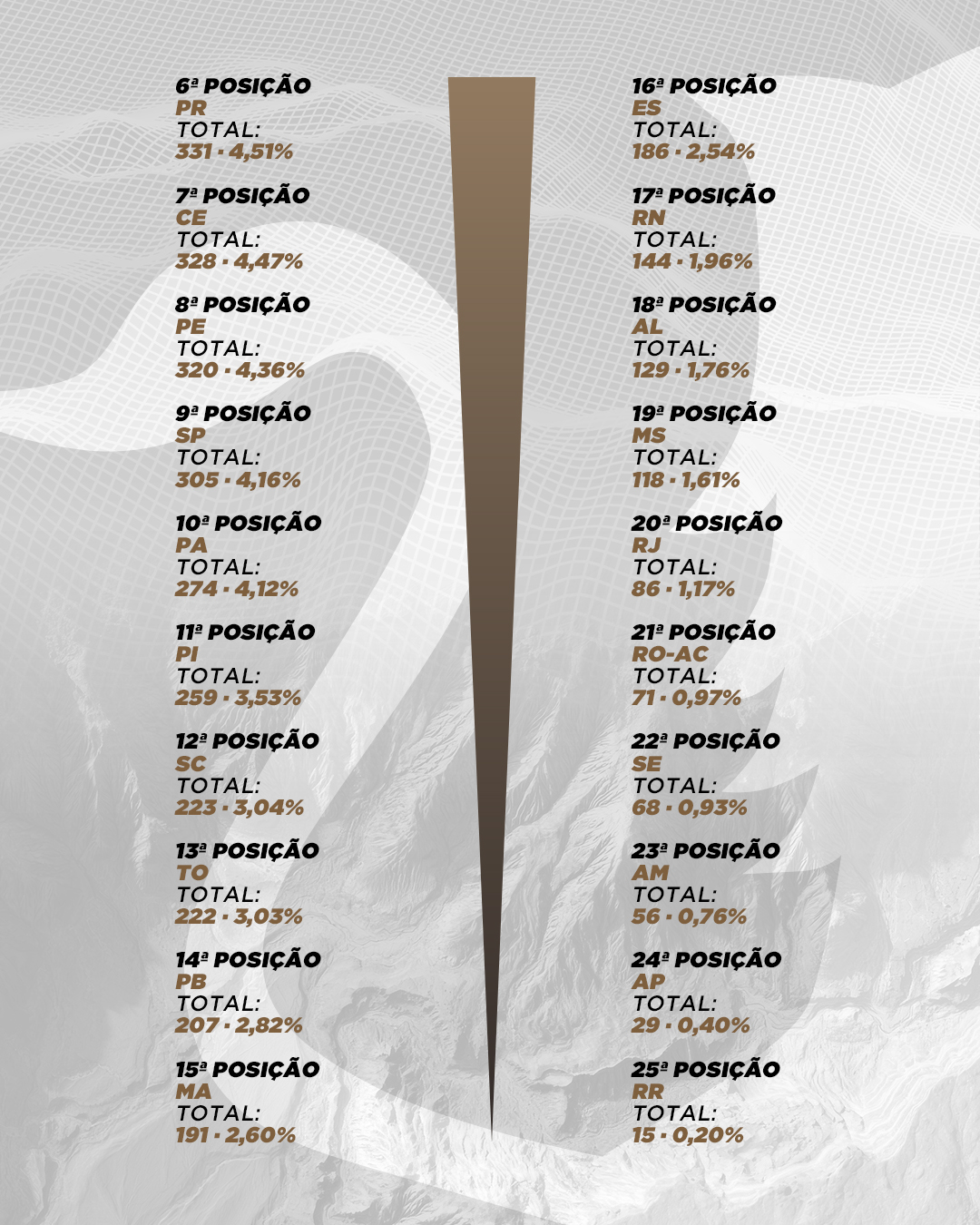
Following the ranking, we find states with robust and diversified mining activity. Pará (PA), São Paulo (SP), and Paraná (PR) demonstrate the sector’s reach.
- Pará (10th Position – 274 permits | 4.12%): Although a giant in mineral production, especially in the Carajás Mineral Province, Pará’s position in the ranking of new permits may indicate a greater maturity of its established projects. Exploration in the region is often dominated by large companies with long-term projects, while the number of permits may reflect more research activity in smaller-scale areas or for substances less traditional to the region.
- São Paulo (9th Position – 305 permits | 4.16%) and Paraná (6th Position – 331 permits | 4.51%): The strong presence of states like São Paulo and Paraná is intrinsically linked to the demand for construction materials (sand, crushed stone, clay) and for industry. Proximity to large consumer centers makes the exploitation of these mineral resources economically attractive and essential for infrastructure development.
Interpreting the Data
The 2025 outlook, based on the 7,334 published permits, points to the consolidation of traditional hubs, such as Minas Gerais and Bahia, and the growth of regions focused on strategic minerals, like Goiás. At the same time, the strong presence of industrialized states reinforces the importance of mineral resources for domestic consumption and national infrastructure development.
For professionals and companies in the sector, this data serves as a market thermometer, indicating where exploration opportunities are concentrating. Given this scenario, how do you interpret the distribution of new permits, and what trends do they signal for the future of Brazilian mining?
📷Image Credit: AI-Generated
📷Grafics – Diego Santos