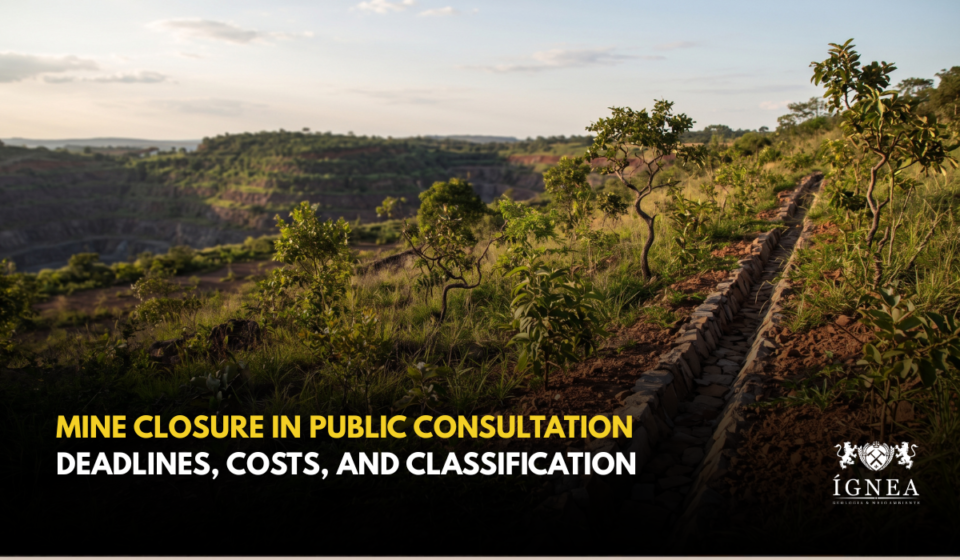
On October 30, 2026, the National Mining Agency (ANM) opened Public Consultation No. 04/2026 on Draft ANM Resolution No. 20650875, which proposes to replace ANM Resolution No. 68/2021 and to define how mine closure must be planned, carried out, and approved. Contributions are accepted until December 29, 2026. Because the draft is still under consultation, the rules described below are proposals and may change before the final version.
The draft’s main proposals are grouped in the questions below. Click to see the answer.
Who Would Be Subject to the Rules, and What Are the Instruments?
The draft applies to mines under a mine manifest (minas manifestadas), exploitation applications and Development Concessions, license registrations, small-scale mining permits, extraction registrations, and Experimental Mining Licenses (GU) (art. 1, §1). Closure would be managed through four instruments (art. 5):
- the Preliminary Closure Component (CPFM), submitted with the exploitation application or the GU application;
- the Mine Closure Plan (PFM), subject to ANM approval;
- the Annual Execution Report (RAE-PFM);
- the Final Execution Report (RFE-PFM), used to request approval of the closure.
These obligations last for the entire life cycle of the operation and do not end with suspension, relinquishment, or extinguishment of the title (art. 1, §2).
When Must the PFM Be Submitted?
The first PFM must be submitted on whichever of these dates comes first (art. 8, §1):
- within 12 months of the grant of the exploitation title;
- before extraction begins or any relevant structure is built.
For activities under an Experimental Mining License (GU), the deadline is up to 12 months from the start of extraction, unless relevant structures are built earlier (art. 8, §3).
Who Can Submit the Simplified PFM?
Proportionality is the core of the proposal. The PFM will be Simplified only if the operation meets all five criteria of Annex I at the same time:
- a disturbance footprint of up to 10 hectares (Development Concession) or 5 hectares (other regimes);
- no dam covered by the National Dam Safety Policy;
- no waste rock or tailings pile covered by the specific regulation;
- substance, mining method, and production within the limits set in the annex (for example, up to 100,000 t/year ROM of sand, clay, and saibro (weathered rock), or 12,000 t/year ROM of small-scale (garimpo) substances recovered without mercury or cyanide);
- a location outside protected areas, such as conservation units, demarcated Indigenous lands, and delimited quilombola territories.
Metallic minerals and the strategic minerals defined by the Ministry of Mines and Energy, among others, are excluded from the simplified model. In all other cases, the PFM will be Complete. The classification is declared by the titleholder and the responsible technical professional, may be reviewed by the ANM, and does not allow the artificial splitting of tenements or areas (art. 9).
What Deadlines and Reports Does the Draft Create?
- an ordinary update of the PFM every five years (art. 14);
- an extraordinary update within 90 days after a material change, such as a significant change in mining method, an assignment, a lease, or a relinquishment (art. 15);
- an annual report from March 1 to 31, covering the previous year (art. 23);
- notice of a critical event immediately, if there is imminent risk, or within five business days in other cases; premature closure must also be reported within five business days, with a preliminary response plan within 30 days (arts. 16 and 17).
What About Costs and Financial Guarantees?
Every PFM will include two cost estimates, both updated annually (arts. 19 and 20):
- life-of-mine closure cost: the amount needed to close the operation in its planned final configuration;
- current-state closure cost: the amount needed to fulfill existing obligations if the activity were closed on the reference date.
The ANM may require proof of sufficient funds in risk situations, such as premature closure or prolonged suspension (art. 21). This proof is not equivalent to a financial guarantee. The draft does not create a general requirement for a financial guarantee, which would depend on a specific resolution (art. 22).
How Is the Closure Completed?
The titleholder submits the final report with evidence that the measures were carried out and that the success and completion criteria were met (arts. 11, 24, and 25). The ANM may approve the closure in full or in part, assign the status “Completed – Under Monitoring,” deny approval, or extend monitoring (art. 26). There is no single monitoring period: it depends on the risks and the observed performance (art. 29).
What Happens During the Transition?
PFMs that have already been approved remain valid and will be adapted to the new regime at the first applicable event, such as an update (art. 42). Those who were already required to have a PFM and have not submitted one will have 12, 18, or 24 months from the date the rules take effect, depending on the risk and the type of PFM; this period organizes the regularization but does not erase the earlier noncompliance (art. 44). Article 44 takes effect 30 days after the resolution is published, and the remaining provisions, 180 days after (art. 51).
How to Contribute?
Anyone who wishes to contribute has until December 29 to access the Brasil Participativo platform with a gov.br account and submit suggestions. Extension requests require justification and at least five days’ notice. The draft and the Regulatory Impact Analysis report are available on the consultation page.
On the same topic, read our articles on PRAD and PFM, post-mining land use, and why the Mine Closure Plan is essential.
Want to know how Ígnea can help with your mining tenements? Contact our team.
Source: ANM Public Consultation No. 04/2026 and ANM news release (October 30, 2026).
📷 AI-Generated Image