Based on the National Mining Agency’s (ANM) Mining Cadastre System, an official survey of Approved Exploration Reports, published from January to September of this year, was carried out with data from each Regional Management.
The Mining Cadastre provides a snapshot of Brazilian exploratory dynamics.
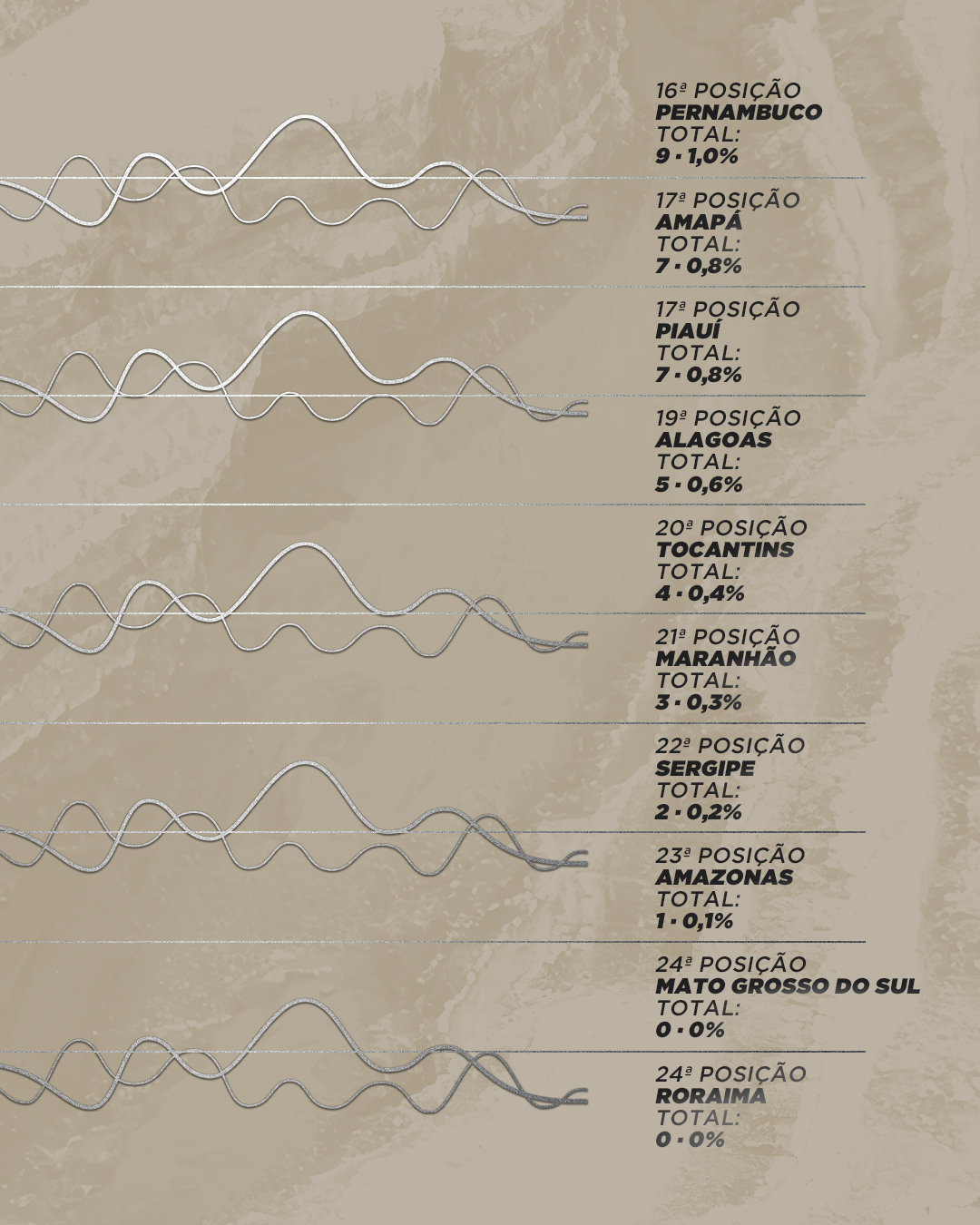
Between January and September 2025, 908 exploration reports were approved throughout the national territory—a number that reflects not only the advancement of geological activity but also the improvement of administrative flows and the documentary conformity required by the ANM.
1. The Legal Importance of the Exploration Report
The Final Exploration Report is the technical-legal instrument that consolidates the fulfillment of the approved Exploration Plan and formally concludes the exploration phase provided for in art. 22 of the Mining Code (Decreto-Lei nº 227/1967).
Its approval by the ANM is an essential requirement for the titleholder to exercise the right to request the Development Concession, in accordance with art. 31 of the same legal decree.
Therefore, each approved report represents:
- The technical proof of the execution of geological exploration;
- The legal validation of the Mining law before the ANM;
- The proof of the existence of the mineral resource.
2. General Performance and Regional Concentration
The report shows a great regional asymmetry in the distribution of approvals. The data indicates:
| Position | Regional Management (State) | Approved Reports (Jan–Sep/2025) | Share (%) |
| 1st | Minas Gerais | 190 | 20.9% |
| 2nd | São Paulo | 174 | 19.2% |
| 3rd | Mato Grosso | 60 | 6.6% |
| 4th | Paraná | 57 | 6.3% |
| 5th | Goiás / Federal District | 50 | 5.5% |
| 6th | Santa Catarina | 48 | 5.3% |
| 6th | Rio Grande do Sul | 48 | 5.3% |
| 8th | Ceará | 46 | 5.1% |
| 9th | Bahia | 45 | 5.0% |
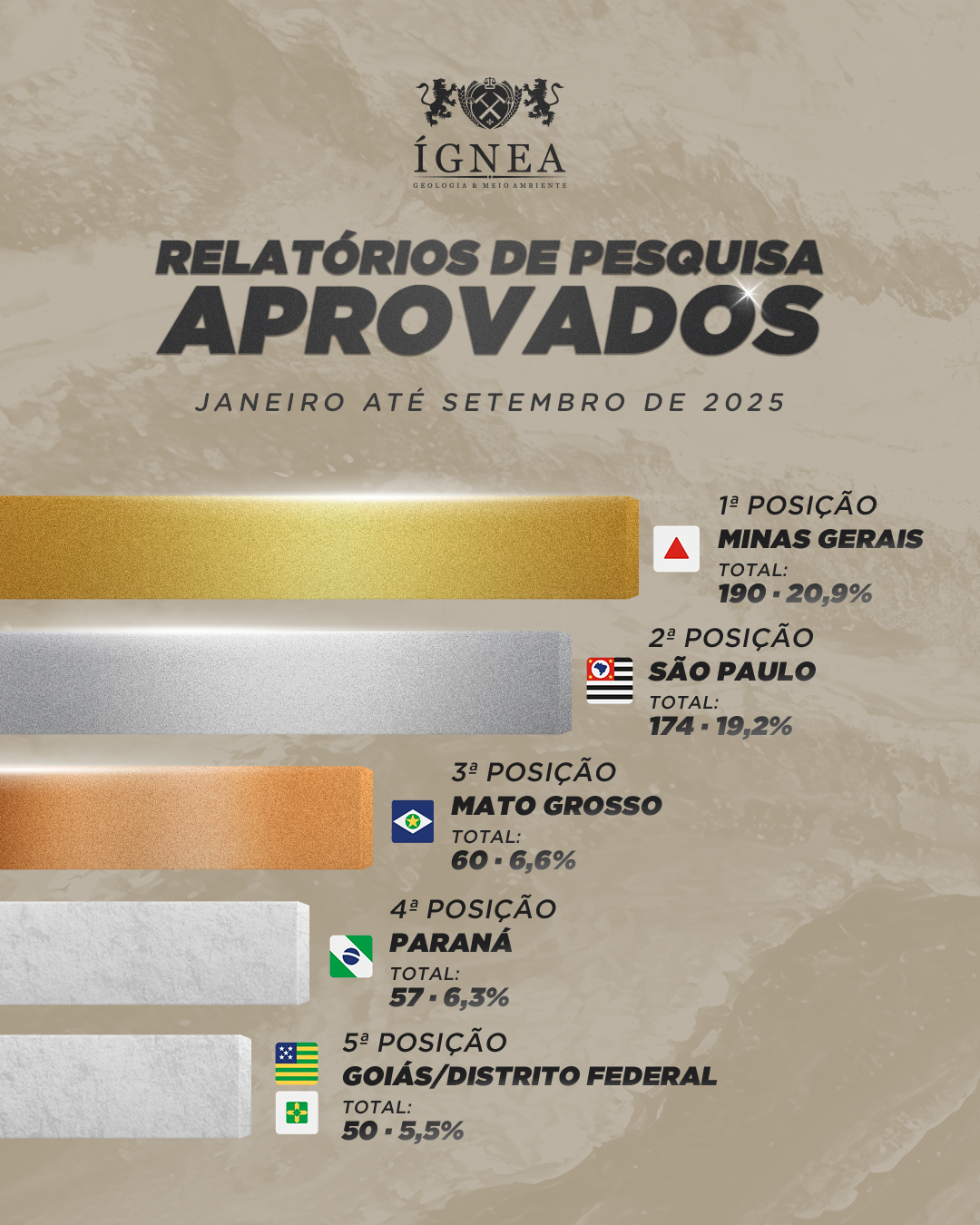
These top nine states concentrate almost 80% of all approvals in the country, forming a technical-administrative axis centered in the Southeast and Midwest regions.
The leadership of Minas Gerais and São Paulo, which together account for more than 40% of national approvals, is consistent with the consolidated structure of their ANM Regional Managements and with the geological and industrial maturity of these jurisdictions.
- In Minas Gerais, reports focused on metallic substances and strategic minerals, such as iron, lithium, phosphate, and gold, predominate, many of which are associated with areas in the Jequitinhonha Valley and the expansion of the lithium-graphite corridor.
- In São Paulo, the focus is on civil construction aggregates and ornamental rocks, whose exploration and processing cycles are shorter, explaining the high volume of approved reports.
Mato Grosso, Paraná, and Goiás show expressive growth, demonstrating the expansion of the exploration base and the institutional strengthening of these managements.
4. Normative Aspects and Procedural Conformity
From a legal point of view, the volume of reports approved in 2025 may be related to:
- Procedural regularity in the submission of final reports within the legal deadline, in conformity with art. 30 of ANM Resolution nº 24/2020;
- Greater technical consistency of the submitted pieces, reflected in the reduction of complementary requirements and administrative rework;
- Improvement of ANM’s internal controls, with emphasis on documentary traceability, georeferencing, and digital validations.
This evolution is beneficial both for the investor and for the Administration, as it confers greater legal certainty to the mining cycle and reduces administrative litigation in later phases (Development Concession or assignments).
5. Regional Considerations and Perspectives
The statistical behavior indicates:
- Southeast consolidated as the technical core of national mining;
- Midwest in expansion, with emphasis on Mato Grosso, which is consolidating as a new exploration hub for gold and phosphate;
- Northeast on the rise, with Bahia and Ceará demonstrating an increase in approvals linked to energy transition minerals;
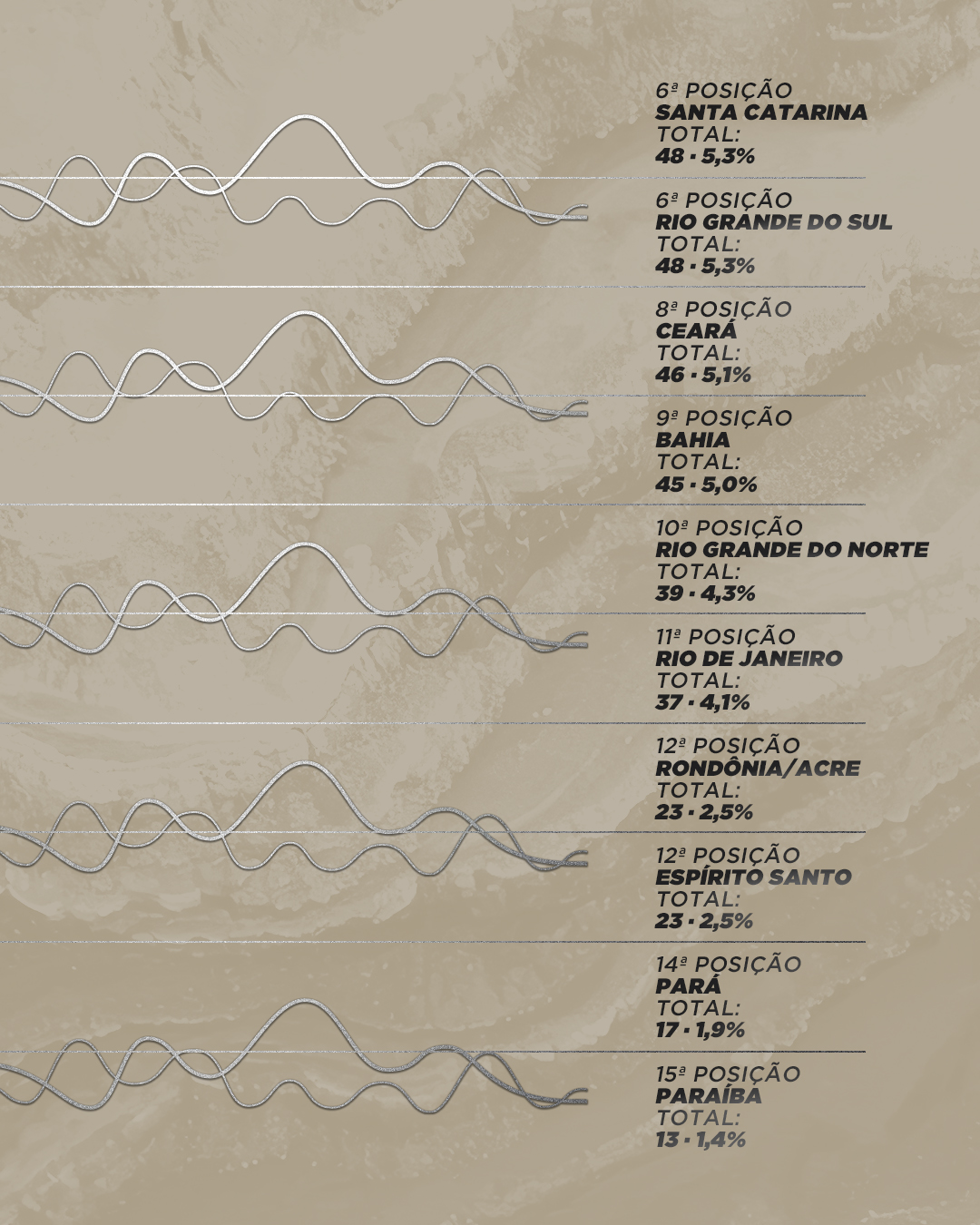
- Low Amazon representation, with Rondônia, Pará, and Amapá registering percentages below 3%.
7. Conclusion
The ranking of exploration reports approved by the ANM until September 2025 confirms a positive trend of administrative efficiency, technical maturity, and legal certainty in the Brazilian mining sector.
With 908 approved reports and a strong concentration in the managements of Minas Gerais and São Paulo, an environment of greater predictability and professionalization is observed in both exploration practices and the legal management of processes.
However, the challenge remains in the balanced regional distribution and the strengthening of technical structures in the North and Northeast regions, so that the advancement of mineral exploration is nationally integrated and legally stable.
Reference:
AGÊNCIA NACIONAL DE MINERAÇÃO (ANM). Approved Exploration Reports — Published month by month per Regional Management (until Jan/2025). Mining Cadastre System. Prepared by: Paulo Ribeiro de Santana.
📷Canva/Edition by ÍGNEABR